I remember talking to someone who wanted to buy a new car but was completely stuck between two choices.
One option was a petrol car.
It was familiar.
Easy to refuel.
Cheaper to buy.
Every mechanic knew how to work on it.
The other option was an electric car.
It was quiet.
Modern.
Cheaper to charge.
And it needed less regular maintenance.
At first, the decision looked simple.
The electric car seemed better for the future.
The petrol car seemed safer for today.
But after looking deeper, the answer was not the same for every driver.
A city driver with home charging may love an electric car.
A long-distance driver in an area with weak charging infrastructure may still prefer petrol.
A family on a tight budget may care more about purchase price.
A daily commuter may care more about fuel savings.
That is why the question is not only:
“Are electric cars better than petrol cars?”
The better question is:
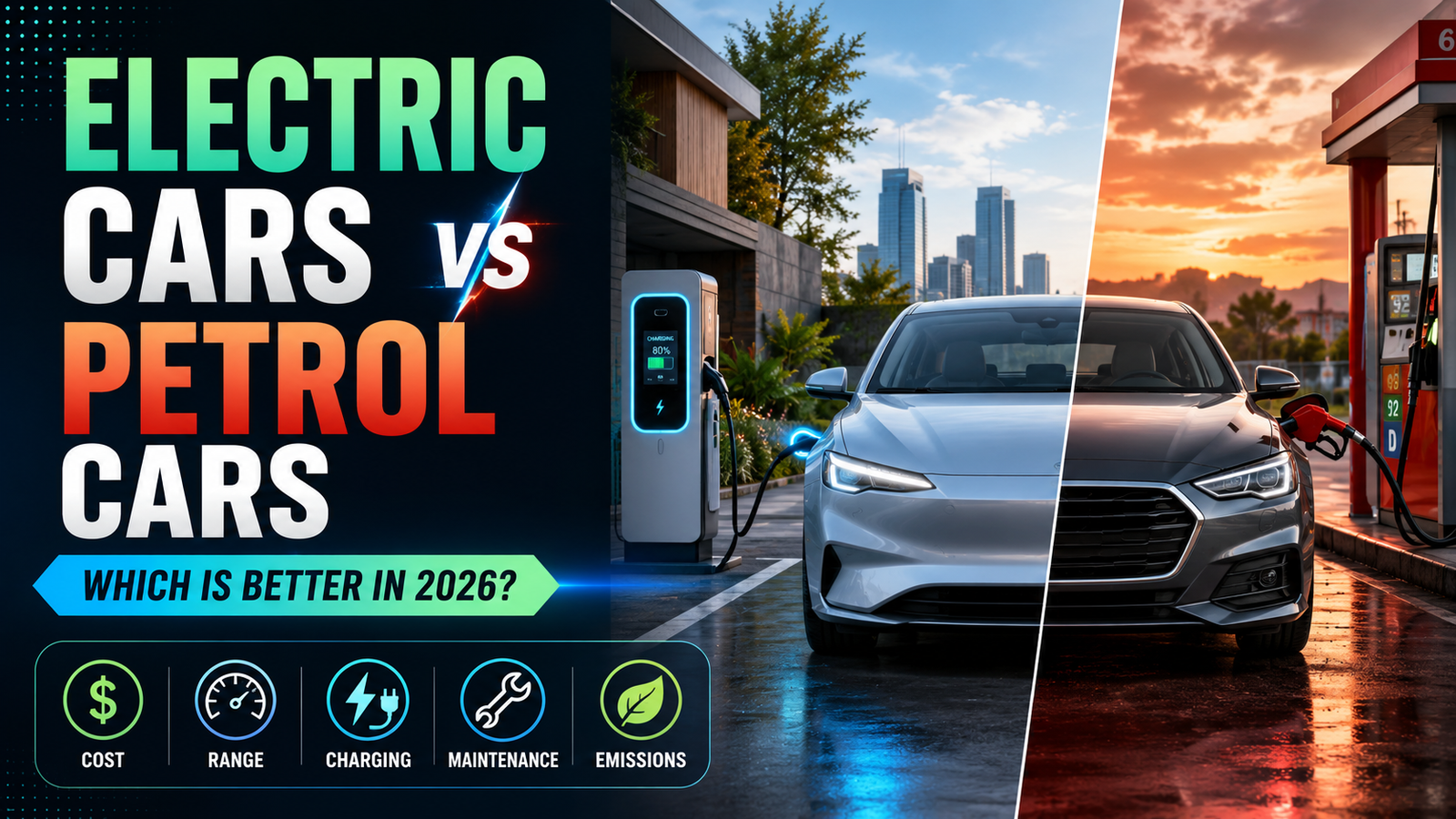
“Which one is better for your driving life in 2026?”
Electric cars have improved a lot. More models are available, charging networks are growing, and many EVs are now practical for daily use. In 2025, electric car sales passed 20 million globally, meaning about one in four new cars sold worldwide was electric.
But petrol cars are not useless.
They are still easier to refuel, often cheaper to buy, and more convenient in places where charging stations are limited.
This guide compares electric cars and petrol cars in a simple, practical way so you can decide which one makes more sense in 2026.
Important: Car prices, fuel prices, electricity costs, charging availability, taxes, incentives, insurance, and resale values vary by country and city. Always compare real local costs before buying.
Table of Contents
- Quick Answer: Electric or Petrol — Which Is Better in 2026?
- Key Facts About Electric Cars vs Petrol Cars
- What Is the Basic Difference?
- Purchase Price
- Fuel and Charging Costs
- Range and Long-Distance Driving
- Charging vs Refueling Convenience
- Maintenance and Repair Costs
- Driving Experience
- Battery Life and Reliability
- Environmental Impact
- Resale Value
- Safety
- Which One Is Better for Different Drivers?
- Common Mistakes Buyers Make
- Simple Buying Checklist
- FAQs About Electric Cars vs Petrol Cars
- Final Thoughts
- Sources and Further Reading
Quick Answer: Electric or Petrol — Which Is Better in 2026?
For many daily drivers, an electric car is the better choice in 2026 if:
- You drive mostly in the city
- You can charge at home or work
- Your daily driving distance is predictable
- You want lower running costs
- You want quiet and smooth driving
- You want less routine maintenance
- Your area has reliable charging stations
- You plan to keep the car for several years
A petrol car may still be better if:
- You regularly drive long distances
- You live where charging stations are limited
- You cannot charge at home
- You need the lowest possible purchase price
- You want faster refueling
- You often travel to remote areas
- You want easier repair options
- You are buying a very cheap used car
In simple words:
Electric cars are usually better for daily city use, lower running costs, quiet driving, and reduced emissions.
Petrol cars are usually better for lower upfront cost, quick refueling, long-distance flexibility, and areas with weak charging infrastructure.
The best choice depends on your budget, location, driving distance, and charging access.
Key Facts About Electric Cars vs Petrol Cars
| Category | Electric Car | Petrol Car |
|---|---|---|
| Energy source | Battery and electric motor | Petrol engine |
| Refueling/charging | Needs charging point | Needs petrol station |
| Daily running cost | Usually lower | Usually higher |
| Purchase price | Often higher, but gap is shrinking | Often lower |
| Maintenance | Usually less routine maintenance | More regular maintenance |
| Oil changes | Not needed in full EVs | Needed regularly |
| Brake wear | Often lower due to regenerative braking | Normal brake wear |
| Long trips | Depends on charging network | Easier in most areas |
| Refuel time | Longer charging time | Usually a few minutes |
| Tailpipe emissions | None | Produces exhaust emissions |
| Driving feel | Quiet, smooth, instant torque | Familiar engine feel |
| Best for | City driving and daily commuting | Long trips and low-infrastructure areas |
Electric cars are far more energy-efficient than petrol cars. The EPA says EVs use about 87%–91% of energy from the battery and regenerative braking to move the vehicle, while gasoline vehicles convert only about 16%–25% of gasoline energy into movement.
1. What Is the Basic Difference?
The biggest difference is how the car moves.
A petrol car uses an internal combustion engine.
Fuel is burned inside the engine.
That combustion creates power.
The power goes through the transmission and moves the wheels.
An electric car uses a battery and electric motor.
The battery stores electricity.
The motor uses that electricity to turn the wheels.
There is no petrol engine in a full electric car.
That means a full EV does not need:
- Engine oil changes
- Spark plugs
- Fuel injectors
- Exhaust system maintenance
- Traditional engine belts
- Petrol tank filling
- Emission-system repairs
This does not mean electric cars need no maintenance.
They still need:
- Tires
- Brakes
- Suspension checks
- Cabin filter
- Coolant system checks
- Battery health care
- Wiper blades
- Lights
- Wheel alignment
- Software updates
A petrol car has more mechanical parts, but it is also familiar.
Many drivers understand petrol cars better.
Mechanics are easier to find.
Parts may be more available.
This is why the comparison is not only about technology.
It is also about convenience.
2. Purchase Price
Purchase price is one of the biggest factors for most buyers.
Electric cars often cost more to buy than similar petrol cars, especially when comparing new vehicles.
This is mainly because of the battery.
The battery is one of the most expensive parts of an EV.
However, the price gap has been getting smaller in many markets.
More electric models are available now, and competition from Chinese EV makers has helped lower prices in several regions. The IEA reported that imports from China accounted for 55% of electric car sales in 2025 in countries outside Europe and the United States, compared with less than 5% five years earlier.
Why petrol cars may still be cheaper upfront
Petrol cars may be cheaper because:
- The technology is older and widely produced
- Used petrol cars are easier to find
- More budget models are available
- Repairs and parts are familiar
- Buyers may have more financing options
- Smaller petrol cars can be very affordable
For buyers with a limited budget, the petrol car may look more attractive at first.
But purchase price is only one part of ownership.
You also need to calculate fuel, maintenance, insurance, taxes, depreciation, and resale value.
Why EVs can become cheaper over time
An EV may cost more at the beginning but save money later through:
- Lower charging cost
- Less routine maintenance
- No engine oil changes
- Fewer engine-related repairs
- Less brake wear in many cases
- Possible tax benefits or incentives in some countries
AAA’s 2025 cost analysis found that EVs had lower operating costs, especially for fuel and maintenance, although higher ownership costs like depreciation, insurance, fees, and financing could still make them more expensive overall in that study.
Simple rule
If you only look at the showroom price, petrol may win.
If you look at five years of daily use, an electric car may become more competitive.
The real answer depends on your local electricity price, petrol price, driving distance, and purchase price difference.
3. Fuel and Charging Costs
This is where electric cars often become very attractive.
Charging an electric car is usually cheaper than buying petrol for the same distance, especially if you charge at home during lower-cost electricity hours.
Petrol prices can change quickly.
They depend on oil markets, taxes, transport costs, and local fuel policies.
Electricity prices can also rise, but home charging is often still cheaper than petrol in many places.
Why EV charging can be cheaper
Electric cars are more efficient.
They waste less energy.
They do not burn fuel inside an engine.
They also recover some energy while slowing down through regenerative braking.
That is why an EV can travel a useful distance using less energy cost than a petrol car.
But charging cost is not always the same
Charging cost depends on where you charge.
Home charging is usually the cheapest.
Workplace charging may be cheap or free in some cases.
Public fast charging is often more expensive.
Ultra-fast charging can cost much more than home charging.
If you depend only on public fast chargers, your EV savings may be smaller.
Petrol cost advantage
Petrol has one big convenience advantage.
You can refill quickly.
You do not need to plan charging.
You do not need a home charger.
You do not need parking with electricity access.
For apartment residents, renters, and people without private parking, petrol can still be easier.
4. Range and Long-Distance Driving
Range means how far a car can travel before it needs more energy.
For petrol cars, range depends on fuel tank size and fuel economy.
For electric cars, range depends on battery size, efficiency, temperature, speed, driving style, and use of air conditioning or heating.
EV range has improved
Many modern electric cars can easily handle normal daily driving.
For city use, school runs, office commutes, shopping, and local trips, range is usually not a problem if the driver charges regularly.
The EPA also notes that EVs have improved enough that many can handle daily travel needs, and range concerns often depend on real driving habits and charging access.
Where petrol still wins
Petrol cars still have an advantage for:
- Long highway trips
- Remote areas
- Emergency travel
- Areas with weak charging networks
- Drivers who cannot wait for charging
- People who travel without planning stops
A petrol car can usually be refueled in a few minutes.
An EV may need more time, especially if using slower charging.
Real-world EV range can change
An electric car’s range may drop because of:
- High speed
- Cold weather
- Very hot weather
- Heavy load
- Mountain driving
- Aggressive acceleration
- Low tire pressure
- Frequent fast charging habits
- Battery age
Petrol cars are also affected by speed, load, traffic, and driving style, but refueling is usually easier.
5. Charging vs Refueling Convenience
This is one of the most important practical differences.
A petrol car is simple.
When fuel is low, you go to a petrol station.
Fill the tank.
Pay.
Drive away.
An electric car works differently.
You may charge at home, at work, at a public charger, or during a road trip.
Home charging is the EV advantage
If you can charge at home, an EV becomes much easier to live with.
You can plug in at night and start the next day with enough range.
That means fewer visits to petrol stations.
For many daily drivers, this is one of the biggest EV benefits.
Public charging is improving
Public charging infrastructure is growing quickly. The IEA reported that almost 1.8 million public charging points were added globally in 2025, bringing the total to more than 7 million public charging points worldwide by the end of 2025.
That is a big improvement.
But charging availability is not equal everywhere.
Some cities have many chargers.
Some highways have strong networks.
Some rural areas still have very few options.
Charging can still be frustrating
EV charging may be inconvenient if:
- Chargers are broken
- Chargers are busy
- Charging speed is slow
- Payment apps are confusing
- The charging station is far away
- You cannot charge at home
- Fast charging is expensive
- The car charges slower in cold weather
This is why charging access should be checked before buying an EV.
Do not buy based only on the advertised range.
Check where you will actually charge.
6. Maintenance and Repair Costs
Electric cars usually require less routine maintenance than petrol cars.
The U.S. Alternative Fuels Data Center explains that all-electric vehicles need less maintenance because they have fewer moving parts, fewer fluids such as engine oil, reduced brake wear from regenerative braking, and battery/motor electronics that need little regular maintenance.
EV maintenance advantages
A full electric car does not need:
- Engine oil changes
- Spark plug replacement
- Fuel filter replacement
- Exhaust system repair
- Timing belt replacement
- Traditional engine tune-ups
- Many engine-fluid services
This can save time and money.
EVs still need maintenance
EVs still need:
- Tire rotations
- Tire replacement
- Brake fluid checks
- Cabin filter replacement
- Coolant checks
- Suspension inspection
- Wheel alignment
- Wiper blades
- Air conditioning service
- Software updates
- Battery cooling-system checks in some models
EV tires may wear faster in some cases because electric cars can be heavier and have strong instant torque.
So while EVs reduce engine maintenance, they do not remove all running costs.
Petrol maintenance
Petrol cars need more regular maintenance, including:
- Oil changes
- Oil filter replacement
- Spark plugs
- Air filter
- Fuel system cleaning
- Transmission service
- Coolant service
- Exhaust maintenance
- Belts and hoses
- Emissions system repairs
The advantage is that petrol-car mechanics are easy to find in most places.
Parts are often widely available.
Repairs may be simpler in smaller cities or rural areas.
7. Driving Experience
Electric cars and petrol cars feel different.
An electric car is usually smooth and quiet.
There is no engine vibration like a petrol car.
Power delivery is instant.
When you press the accelerator, the response can feel very quick.
This makes EVs enjoyable in city traffic.
EV driving feel
Electric cars usually offer:
- Smooth acceleration
- Quiet cabin
- Instant torque
- Less vibration
- One-pedal driving in some models
- Regenerative braking
- Modern digital features
Many drivers enjoy the calm feeling of an EV.
It can make daily commuting less stressful.
Petrol driving feel
Petrol cars offer:
- Familiar engine sound
- Traditional gear changes
- Quick refueling
- Lighter weight in many models
- Easier long-distance confidence
- More familiar driving behavior
Some drivers still prefer the sound and feel of a petrol engine.
For driving enthusiasts, a petrol car may feel more emotional.
For daily comfort, an EV may feel more relaxing.
8. Battery Life and Reliability
One common fear about electric cars is battery failure.
Many buyers worry that the battery will need replacement after only a few years.
In reality, EV batteries are designed to last a long time.
The EPA says EV battery replacements due to failure are uncommon, and recent data shows low failure rates, especially for newer models.
The Alternative Fuels Data Center also notes that many manufacturers offer 8-year/100,000-mile warranties for EV batteries.
What affects battery health?
Battery health can be affected by:
- Extreme heat
- Extreme cold
- Frequent ultra-fast charging
- Regularly charging to 100%
- Deep discharging to very low levels
- Poor thermal management
- High mileage
- Age
- Battery chemistry
Modern EVs manage battery temperature better than older models.
But battery care still matters.
Simple EV battery care tips
To protect battery health:
- Avoid keeping the battery at 100% all the time
- Avoid letting the battery stay near 0%
- Use fast charging when needed, not for every charge
- Park in shade during extreme heat when possible
- Follow the manufacturer’s charging guidance
- Keep software updated
- Check battery warranty terms before buying
Petrol reliability
Petrol cars can also be reliable, especially when maintained properly.
But petrol engines have more moving parts.
They may develop issues with:
- Spark plugs
- Fuel injectors
- Timing belts
- Oil leaks
- Cooling systems
- Exhaust systems
- Transmission parts
- Sensors
- Emissions equipment
A petrol car can last many years with good maintenance.
An electric car can also last many years, but battery condition becomes an important factor, especially when buying used.
9. Environmental Impact
Electric cars usually produce fewer emissions over their lifetime than petrol cars, but the full answer is not as simple as saying “EVs are always clean.”
EVs have no tailpipe emissions.
That means no exhaust smoke from the car itself.
This helps improve air quality in cities.
However, electricity generation can still create emissions depending on the local power grid.
Battery manufacturing also creates emissions.
Still, the EPA says EVs typically have a smaller carbon footprint than gasoline cars, even when accounting for electricity used for charging. It also says lifetime greenhouse gas emissions from EVs are typically lower than those from average gasoline vehicles, even when manufacturing is included.
EV environmental advantages
Electric cars can help reduce:
- Tailpipe pollution
- Urban exhaust emissions
- Oil dependence
- Engine noise pollution
- Greenhouse gas emissions over time
Their benefit becomes stronger when electricity comes from cleaner energy sources such as solar, wind, hydro, or nuclear power.
Petrol environmental disadvantages
Petrol cars create emissions while driving.
They burn fuel directly.
They release exhaust gases.
They also depend on fuel extraction, refining, and transport.
Even efficient petrol cars still produce tailpipe emissions.
Important balanced point
EVs are not impact-free.
Battery materials need mining and processing.
Battery production uses energy.
Charging depends on the power grid.
Battery recycling needs improvement.
But compared with petrol cars, EVs are usually the cleaner option over their full life, especially as electricity grids become cleaner.
10. Resale Value
Resale value is complicated in 2026.
Petrol cars have a long used-car history.
Buyers understand them.
Mechanics understand them.
Parts are available.
That can help resale value, especially in places where EV adoption is still low.
Electric car resale value can vary more.
Some EVs hold value well.
Others depreciate quickly because of:
- Newer models becoming cheaper
- Battery-health concerns
- Changes in incentives
- Rapid technology updates
- Charging-standard changes
- Limited used-EV buyer confidence
- High repair cost fears
What helps EV resale value?
An EV may have better resale value if:
- The brand is trusted
- Battery health is strong
- Range is still practical
- Warranty remains
- Charging standard is common
- Service network is available
- Software support is good
- The model has strong demand
What helps petrol resale value?
A petrol car may hold value better if:
- It has low mileage
- It has full service history
- Parts are cheap
- Fuel economy is good
- The model is popular
- It has no major accident history
- Mechanics know the car well
Used EV warning
When buying a used EV, do not judge only by mileage.
Check battery health.
Check warranty status.
Check charging history if available.
Check whether the battery has been replaced or repaired.
Check if the car supports public chargers in your area.
11. Safety
Both electric and petrol cars can be safe.
Safety depends more on the vehicle’s design, crash rating, tires, brakes, driver behavior, and maintenance than on fuel type alone.
Commercially available electric vehicles must meet the same Federal Motor Vehicle Safety Standards as conventional vehicles in the United States, and EV battery packs are designed with safety protections for conditions such as vibration, extreme temperatures, short circuit, fire, collision, and water immersion.
EV safety points
Electric cars often have a low center of gravity because the battery is placed low in the vehicle.
This can help stability.
They also have high-voltage safety systems designed to isolate the electrical system in certain crash situations.
But EVs require special care after serious collisions, flooding, or battery damage.
Petrol safety points
Petrol cars carry flammable liquid fuel.
They also have hot exhaust systems, fuel lines, and combustion parts.
But petrol vehicles have been tested and improved over many decades.
Mechanics and emergency services are very familiar with them.
Safety advice for both
For both electric and petrol cars:
- Keep tires in good condition
- Maintain brakes
- Do not ignore warning lights
- Repair suspension problems
- Follow recall notices
- Use correct child seats
- Avoid overloaded driving
- Drive according to road conditions
The safest car is not only the one with good technology.
It is the one that is properly maintained and driven carefully.
12. Which One Is Better for Different Drivers?
There is no single winner for everyone.
The better choice depends on your driving pattern.
Best for city drivers: Electric car
An EV is often better for city drivers because:
- Short trips suit EVs well
- Regenerative braking helps in traffic
- Home charging can be convenient
- Running cost can be lower
- Quiet driving reduces stress
- No tailpipe emissions in traffic
Best for long-distance drivers: Petrol car or hybrid
A petrol car may still be better for long-distance drivers because:
- Refueling is faster
- Petrol stations are widely available
- No charging planning is needed
- Remote routes are easier
- Highway range is predictable
A hybrid can also be a strong middle option.
It gives better fuel economy than a traditional petrol car while avoiding charging dependence.
Best for budget buyers: Depends on local market
If buying new, a petrol car may have a lower purchase price.
If driving a lot every month, an EV may save more over time.
If buying used, a petrol car may be easier and cheaper to find.
A used EV can be good, but only if the battery is healthy and charging support is available.
Best for apartment residents: Petrol or hybrid
If you cannot charge at home, an EV can become less convenient.
Public charging can work, but it requires planning.
For apartment residents without reliable charging, petrol or hybrid may be easier.
Best for eco-conscious drivers: Electric car
For drivers who want lower lifetime emissions, an electric car is usually the better option, especially in areas with cleaner electricity.
Best for remote areas: Petrol car
In remote areas, petrol still has a major advantage.
Fuel stations are usually easier to find than fast chargers.
Repair support may also be better for petrol cars.
Common Mistakes Buyers Make
Mistake 1: Looking only at purchase price
A cheaper car can become expensive if fuel, repairs, or depreciation are high.
Compare total ownership cost, not only showroom price.
Mistake 2: Buying an EV without checking charging
Before buying an EV, check:
- Home charging options
- Workplace charging
- Nearby public chargers
- Highway chargers
- Charging cost
- Charger reliability
- Charging connector compatibility
Mistake 3: Believing advertised range blindly
Real-world EV range depends on speed, weather, road conditions, load, tire pressure, and driving style.
Always keep a range buffer.
Mistake 4: Ignoring petrol running costs
Petrol cars may be cheaper to buy but more expensive to run if fuel prices are high.
Mistake 5: Forgetting insurance and repair costs
Some EVs can cost more to insure or repair.
Some petrol cars can also be expensive if parts are rare.
Get insurance quotes before buying.
Mistake 6: Thinking EVs need no maintenance
EVs need less routine maintenance, but they still need tires, brakes, suspension, filters, coolant checks, and inspections.
Mistake 7: Buying a used EV without battery checks
Battery health is one of the most important checks for a used EV.
Do not skip it.
Mistake 8: Ignoring local service support
A car is only practical if you can service and repair it easily.
Check nearby service centers.
Mistake 9: Assuming petrol cars are outdated
Petrol cars still make sense for many drivers, especially where EV support is limited.
Mistake 10: Not calculating your own driving needs
Do not buy based on trends.
Buy based on your real life.
Simple Buying Checklist
Before choosing between electric and petrol, ask these questions:
- How much can I spend upfront?
- How many kilometers or miles do I drive per week?
- Can I charge at home?
- Are public chargers available near me?
- Do I often drive long distances?
- Do I travel to remote areas?
- What is the local electricity price?
- What is the local petrol price?
- Is insurance higher for either option?
- Are mechanics and service centers available?
- How long will I keep the car?
- What is the resale market like?
- Do I want lower running costs or lower purchase price?
- Am I comfortable planning charging stops?
- Do I need instant convenience?
If you can answer these honestly, the decision becomes much easier.
FAQs About Electric Cars vs Petrol Cars
Are electric cars better than petrol cars in 2026?
For many daily city drivers, yes. Electric cars can offer lower running costs, smoother driving, less routine maintenance, and lower emissions. But petrol cars may still be better for long trips, remote areas, lower purchase price, and drivers without charging access.
Are petrol cars still worth buying in 2026?
Yes. Petrol cars are still worth buying if you need fast refueling, lower upfront cost, easy repairs, wide fuel availability, or long-distance flexibility.
Do electric cars really save money?
They can save money on charging and maintenance, especially for drivers who charge at home and drive regularly. But total savings depend on purchase price, electricity cost, petrol cost, insurance, depreciation, and repair costs.
Are electric cars cheaper to maintain?
Usually, yes. Full electric cars have fewer moving parts, fewer fluids, no oil changes, and reduced brake wear from regenerative braking. But tires, brakes, suspension, filters, and battery cooling systems still need attention.
Is charging an EV cheaper than petrol?
In many cases, yes, especially with home charging. Public fast charging can be more expensive, so the savings depend on where you charge.
How long do EV batteries last?
EV batteries are designed for long life. Many manufacturers offer warranties around 8 years or 100,000 miles, though terms vary by brand and country.
Are EV batteries expensive to replace?
Yes, battery replacement can be expensive outside warranty. That is why battery health and warranty status are important when buying a used EV.
Can electric cars handle long trips?
Yes, many can. But long trips require more planning than petrol cars, especially where fast chargers are limited.
Are electric cars good for cold weather?
They can work well in cold weather, but range may drop. Battery heating, cabin heating, and winter tires can affect energy use.
Are petrol cars more reliable?
Not always. Petrol cars are familiar and easy to repair, but they have more moving parts. EVs have fewer mechanical parts but depend heavily on battery, electronics, and software health.
Which is better for city driving?
Electric cars are usually better for city driving because they are quiet, efficient, smooth, and strong in stop-and-go traffic.
Which is better for highway driving?
Petrol cars may still be more convenient for long highway trips because refueling is quick and fuel stations are widely available. EVs can also work well if fast charging is available on the route.
Are electric cars better for the environment?
Usually, yes over their lifetime. EVs have no tailpipe emissions and typically produce lower lifetime greenhouse gas emissions than petrol cars, even when battery manufacturing and electricity generation are considered.
Should I buy a hybrid instead?
A hybrid can be a good middle choice if you want better fuel economy but are not ready for a full EV. It does not require regular charging like a full EV.
What is the biggest problem with electric cars?
The biggest practical problem is charging access. If you cannot charge at home and public chargers are weak in your area, EV ownership can become inconvenient.
What is the biggest problem with petrol cars?
The biggest long-term problems are fuel cost, regular maintenance, engine wear, emissions, and dependence on petrol prices.
Is a used electric car a good idea?
It can be, but only after checking battery health, warranty status, charging compatibility, service history, and local charging support.
Is a used petrol car safer to buy?
It may be easier to inspect and repair, but it still needs a full mechanical check. Engine, transmission, brakes, tires, and accident history matter.
Which car is better for Pakistan or similar markets?
In markets where charging stations are still limited, petrol cars and hybrids may be more practical for many drivers. Electric cars can still be excellent for city drivers who can charge at home and have service support nearby.
What is the best overall choice in 2026?
For city commuting with home charging, electric is usually better.
For long-distance travel, remote areas, and lower upfront budget, petrol may still be better.
For a balanced option, hybrid can be the safest middle ground.
Final Thoughts
Electric cars are no longer just futuristic vehicles.
They are real daily-use cars.
They are quiet.
Efficient.
Smooth.
Often cheaper to run.
And better for emissions over their lifetime.
The global market is clearly moving toward electrification. Electric cars made up about 25% of new car sales worldwide in 2025, and charging infrastructure is expanding quickly.
But petrol cars still have strengths.
They are familiar.
Easy to refuel.
Often cheaper to buy.
Easier to repair in many places.
And more convenient where charging is not ready.
So which one is better in 2026?
The honest answer is this:
An electric car is better if your daily life fits electric driving.
A petrol car is better if your location, budget, or travel habits still depend on fuel convenience.
Do not buy only because EVs are trendy.
Do not buy petrol only because it feels familiar.
Look at your real driving.
Your parking.
Your charging access.
Your monthly fuel cost.
Your repair options.
Your long trips.
Your budget.
The best car is not the one that wins every online debate.
It is the one that works best for your life.
Sources and Further Reading
- International Energy Agency — Global EV Outlook 2026: Electric car sales and market trends.
- International Energy Agency — Global EV Outlook 2026: Public charging infrastructure.
- U.S. Environmental Protection Agency — Electric Vehicle Myths and EV efficiency facts.
- U.S. Environmental Protection Agency — EV lifetime greenhouse gas emissions.
- U.S. Department of Energy Alternative Fuels Data Center — EV maintenance and safety.
- AAA — New vehicle ownership, EV operating costs, and maintenance cost comparison.
- Your vehicle manufacturer’s owner’s manual
- Local fuel prices, electricity rates, insurance quotes, tax rules, and charging-station maps
About the Author