I remember sitting in a friend’s car one evening when a small warning light appeared on the dashboard.
He looked at it for a second and said, “It is probably nothing.”
A few days later, the car would not start.
The problem was not sudden.
The car had already been giving small signs.
The engine was taking longer to start.
The lights looked slightly weak.
The battery warning had appeared once before.
But because the car was still driving, the problem was ignored.
That is how many car problems begin.
Most car issues do not appear all at once. They usually start with small signs: a strange sound, a warning light, a vibration, a smell, a leak, or a change in how the car feels.
The good news is that drivers do not need to be mechanics to notice early warning signs.
You only need to understand the most common problems, what they may mean, and when to take them seriously.
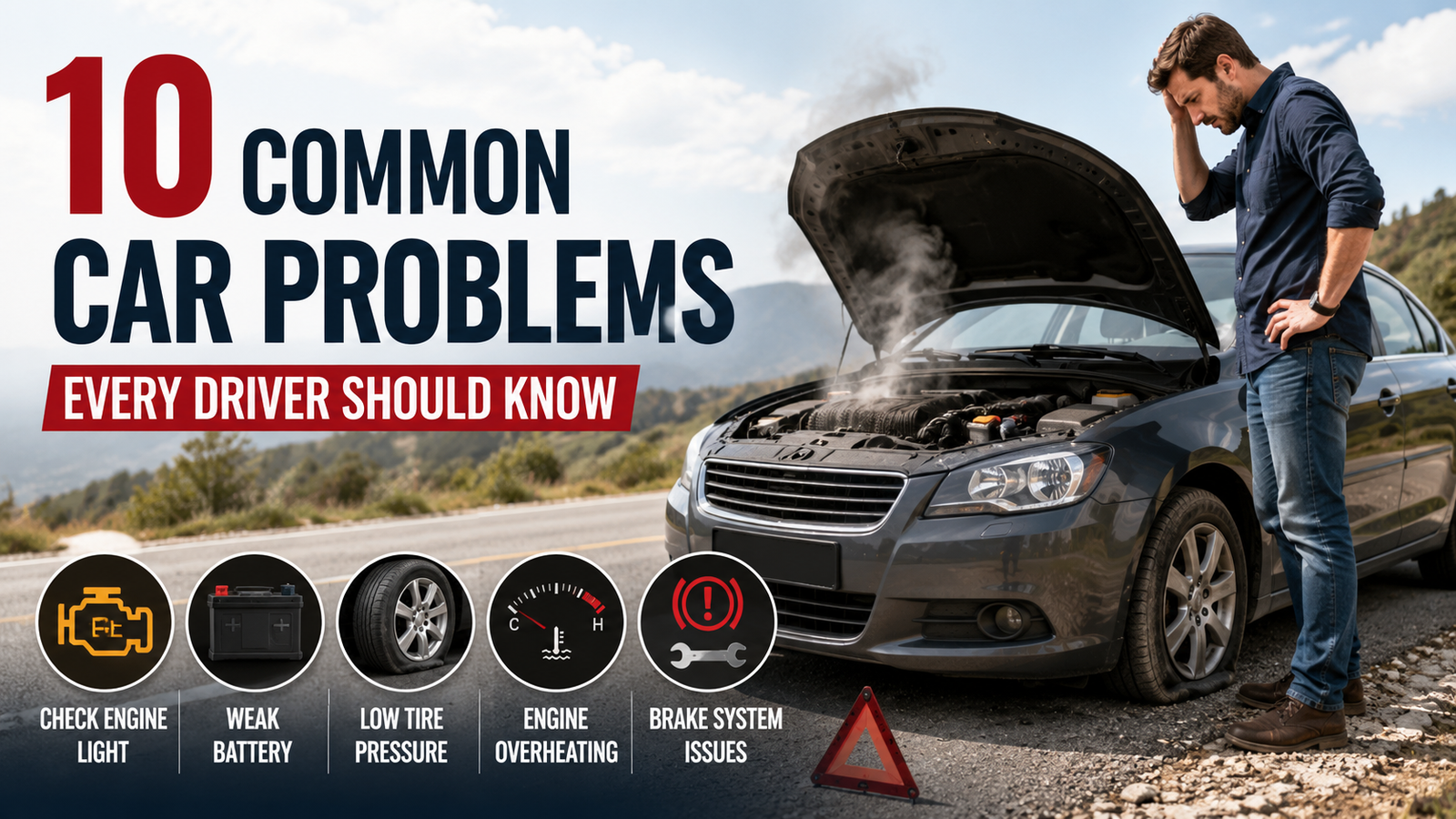
This guide explains 10 common car problems every driver should know, including what causes them, what warning signs to look for, and what you should do next.
Important: This article is for general awareness only. Car problems can vary by vehicle, age, climate, driving style, and maintenance history. If a warning light appears, the car feels unsafe, or you are unsure about a problem, check your owner’s manual and contact a qualified mechanic.
Table of Contents
- Quick Answer: What Are the Most Common Car Problems?
- Key Facts About Common Car Problems
- Dead or Weak Battery
- Flat or Underinflated Tires
- Engine Overheating
- Check Engine Light
- Brake Problems
- Strange Engine Noises
- Oil Leaks or Low Engine Oil
- Transmission Problems
- Faulty Alternator or Charging System
- Suspension and Steering Problems
- How to Reduce Common Car Problems
- Common Mistakes Drivers Make
- When Should You Stop Driving Immediately?
- FAQs About Common Car Problems
- Final Thoughts
- Sources and Further Reading
Quick Answer: What Are the Most Common Car Problems?
The most common car problems include:
- Weak or dead battery
- Flat or underinflated tires
- Engine overheating
- Check engine light
- Brake noise or weak braking
- Strange engine sounds
- Oil leaks or low oil
- Transmission slipping or rough shifting
- Alternator or charging issues
- Suspension and steering problems
Some problems are minor when caught early.
For example, a low tire may only need air if there is no damage.
A dirty air filter may be simple to replace.
A weak battery may only need testing and replacement.
But some problems can become dangerous or expensive if ignored.
Brake failure, severe overheating, low oil pressure, steering issues, and tire damage should always be treated seriously.
The best habit is simple:
Pay attention to changes.
Cars usually communicate through sounds, smells, vibrations, warning lights, and performance changes before they completely fail.
Key Facts About Common Car Problems
| Problem | Common Warning Sign | Possible Cause | What to Do |
|---|---|---|---|
| Weak battery | Slow start, clicking sound | Old battery, short trips, lights left on | Test battery and charging system |
| Low tire pressure | TPMS light, poor handling | Air loss, puncture, temperature change | Check pressure when tires are cold |
| Overheating | Temperature gauge rising | Low coolant, leak, fan issue | Stop safely and let engine cool |
| Check engine light | Dashboard warning light | Sensor, emissions, ignition, fuel issue | Scan diagnostic code |
| Brake problems | Squealing, grinding, vibration | Worn pads, rotor issue, low fluid | Inspect brakes quickly |
| Engine noise | Knocking, ticking, rattling | Low oil, worn parts, belt issue | Avoid ignoring unusual sounds |
| Oil leak | Oil spots under car | Gasket, seal, drain plug issue | Check oil level and inspect leak |
| Transmission issue | Slipping, delayed shifting | Low fluid, wear, internal fault | Get professional inspection |
| Charging issue | Battery light, dim lights | Alternator, belt, wiring problem | Test charging system |
| Steering/suspension | Pulling, shaking, uneven tire wear | Alignment, shocks, joints, tires | Inspect suspension and tires |
1. Dead or Weak Battery
A weak battery is one of the most common reasons a car will not start.
The battery provides the power needed to start the engine. It also supports electrical systems when the engine is not running.
When the battery becomes weak, the car may still work for a while, but it usually starts giving warning signs.
Common signs of a weak battery
You may notice:
- The engine cranks slowly
- The car takes longer to start
- You hear a clicking sound when turning the key
- Dashboard lights appear dim
- Headlights look weaker than usual
- Electrical features act strangely
- The car starts after a jump but fails again later
A weak battery can happen because of age, heat, cold, corrosion, too many short trips, or leaving lights and electronics on while the engine is off.
According to The AA, 12-volt battery faults are one of the most common causes of breakdowns, and flat batteries can be caused by lack of use, short journeys, or electrical items being left on.
What you should do
If your car struggles to start, do not ignore it.
Have the battery tested.
A mechanic or battery shop can usually check:
- Battery health
- Charging voltage
- Alternator output
- Terminal corrosion
- Cable connections
If the battery is old or weak, replacing it early is better than waiting for the car to leave you stranded.
Prevention tips
To reduce battery problems:
- Avoid leaving lights on
- Do not use electronics for long periods when the engine is off
- Clean corrosion from battery terminals
- Drive the car regularly
- Test the battery before extreme weather seasons
- Replace old batteries before they completely fail
A portable jump starter can also be useful, but it should not be treated as a permanent fix.
If the battery keeps dying, there may be a charging problem, parasitic drain, or wiring issue.
2. Flat or Underinflated Tires
Tire problems are common because tires are always exposed to road damage, heat, pressure changes, and wear.
A tire can lose air slowly without looking flat.
That is why many drivers do not notice the problem until the tire-pressure warning light appears or the car starts handling differently.
Common signs of tire problems
You may notice:
- Tire-pressure warning light
- Car pulling to one side
- Soft or heavy steering
- Poor fuel economy
- Uneven tire wear
- Vibration while driving
- Visible cracks, cuts, or bulges
- A nail or sharp object in the tire
Underinflated tires can affect safety, fuel economy, tire life, and vehicle handling. NHTSA advises checking tire pressure and tread regularly, and it says tires should be replaced when tread is worn down to 2/32 of an inch.
What you should do
Check the tire pressure when the tires are cold.
Cold means the car has been parked for several hours or has only been driven a short distance.
Use the recommended tire pressure listed by the vehicle manufacturer. This information is usually found:
- On the driver’s door frame
- Inside the fuel flap
- In the owner’s manual
Do not use the maximum pressure printed on the tire sidewall as the normal pressure target.
That number is not the recommended everyday pressure for your vehicle.
When the tire may be unsafe
Do not keep driving normally if you see:
- A sidewall bulge
- Exposed cords
- A large cut
- Rapid air loss
- Tire separation
- Severe vibration
- A flat tire
A portable tire inflator may help with a slightly low tire, but it cannot repair a damaged tire.
A tire with serious damage needs inspection, repair, or replacement.
3. Engine Overheating
Engine overheating is a problem that should never be ignored.
An engine creates a lot of heat while running. The cooling system controls that heat using coolant, radiator airflow, hoses, a thermostat, a water pump, and fans.
When something goes wrong, the temperature can rise quickly.
Common signs of overheating
You may notice:
- Temperature gauge rising
- Coolant temperature warning light
- Steam from the engine area
- Burning smell
- Reduced engine power
- Coolant leaking under the car
- Heater suddenly blowing cold air
- Engine running roughly
Overheating can happen because of:
- Low coolant
- Coolant leak
- Broken radiator fan
- Faulty thermostat
- Damaged water pump
- Blocked radiator
- Broken hose
- Head gasket problem
What you should do
If the engine temperature rises too high, stop safely as soon as possible.
Turn off the engine and let it cool.
Do not open the radiator cap or coolant reservoir cap while the engine is hot.
Hot coolant is pressurized and can cause serious burns.
After the car cools, check the coolant level if it is safe to do so.
If the coolant is very low, leaking, or the car overheats again, do not continue driving normally.
Why overheating is serious
Driving with an overheating engine can damage:
- Cylinder head
- Head gasket
- Radiator
- Hoses
- Engine block
- Pistons
- Water pump
- Seals
A small coolant leak can become a major engine repair if ignored.
The safest option is to stop early and get the cooling system inspected.
4. Check Engine Light
The check engine light is one of the most confusing dashboard warnings because it can mean many different things.
Sometimes the issue is minor.
Sometimes it is serious.
The light may appear because of problems with:
- Oxygen sensor
- Spark plugs
- Ignition coils
- Fuel system
- Emissions system
- Loose fuel cap
- Airflow sensor
- Catalytic converter
- Engine misfire
- Transmission-related faults
Modern cars monitor many systems, so a check engine light usually needs diagnostic scanning.
Solid light vs flashing light
A solid check engine light often means the car has detected a fault that should be checked soon.
A flashing check engine light is more serious.
It may indicate an active misfire that can damage the catalytic converter or engine if you keep driving.
What you should do
If the check engine light appears:
- Check if the fuel cap is loose
- Notice whether the car is shaking or losing power
- Listen for unusual sounds
- Avoid hard acceleration
- Get the diagnostic code scanned
If the light is flashing, the car is shaking, or you smell fuel, stop driving and get professional help.
Do not simply clear the code without fixing the cause.
Clearing a warning light does not repair the problem.
Why you should not ignore it
Ignoring a check engine light can lead to:
- Poor fuel economy
- Higher emissions
- Engine damage
- Failed inspection
- Expensive repairs
- Breakdowns
A diagnostic scan does not always tell the full repair story, but it gives a useful starting point.
5. Brake Problems
Brake problems are among the most important car issues to take seriously.
A car that starts slowly is inconvenient.
A car that does not stop properly is dangerous.
Brakes naturally wear over time, especially brake pads and rotors.
Driving style, traffic, hills, vehicle weight, and maintenance all affect how quickly brake parts wear.
Common signs of brake problems
You may notice:
- Squeaking or squealing noise
- Grinding sound
- Brake pedal vibration
- Steering wheel shaking while braking
- Soft or spongy brake pedal
- Car pulling to one side when braking
- Brake warning light
- Longer stopping distance
- Burning smell after braking
AAA explains that squeaking or squealing when braking can be a sign of worn brake pads, while vibration in the brake pedal or steering wheel can point to rotor issues.
What different brake sounds may mean
A light squeal may mean brake pads are getting low.
A grinding sound may mean the pads are badly worn and metal is contacting metal.
A clicking or clunking sound may point to loose or worn brake parts.
A soft pedal may suggest air in the brake lines, low brake fluid, or a hydraulic issue.
What you should do
Get the brakes inspected if you notice any unusual sound, vibration, warning light, or change in stopping power.
Do not wait until the sound becomes worse.
Brake repairs are often cheaper when handled early.
Replacing pads early can help protect rotors.
Ignoring worn pads can damage more expensive components.
Stop driving immediately if:
- The brake pedal goes to the floor
- The car does not stop properly
- Brake fluid is leaking
- The brake warning light stays on
- You hear severe grinding
- The car pulls strongly while braking
Brake issues should always be treated as safety issues.
6. Strange Engine Noises
A healthy engine is not silent, but it usually has a consistent sound.
When a new sound appears, it is worth paying attention.
Strange engine noises may be caused by something simple, but they can also warn you before a major failure.
Common engine sounds and possible causes
| Sound | Possible Cause |
|---|---|
| Clicking or ticking | Low oil, valve noise, injector sound |
| Knocking | Low-quality fuel, engine wear, serious internal issue |
| Squealing | Belt slipping, pulley issue |
| Rattling | Loose heat shield, timing chain, exhaust issue |
| Hissing | Vacuum leak, coolant leak, hose problem |
| Grinding | Bearing, pulley, starter, or internal issue |
What you should do
First, notice when the sound happens.
Ask yourself:
- Does it happen when starting?
- Does it happen while accelerating?
- Does it happen while braking?
- Does it happen only when turning?
- Does it change with engine speed?
- Does it continue after the engine warms up?
This information helps a mechanic diagnose the problem faster.
When the sound is urgent
Stop driving and get help if the sound is loud, sudden, metallic, or combined with:
- Oil warning light
- Overheating
- Loss of power
- Smoke
- Burning smell
- Severe vibration
A small ticking sound may be harmless in some cars.
A deep knocking sound can be serious.
When unsure, it is safer to inspect early.
7. Oil Leaks or Low Engine Oil
Engine oil reduces friction, carries heat, and protects moving parts inside the engine.
Low oil or poor oil condition can cause serious engine damage.
Oil leaks are common in older vehicles, but they should not be ignored.
Common signs of oil problems
You may notice:
- Oil spots under the car
- Burning oil smell
- Blue smoke from exhaust
- Low oil warning light
- Oil pressure warning light
- Engine ticking
- Oil level dropping between services
- Dirty or thick oil on dipstick
Common causes of oil leaks
Oil leaks may come from:
- Valve cover gasket
- Oil pan gasket
- Drain plug
- Oil filter
- Rear main seal
- Timing cover
- Turbocharger oil lines
- Worn engine seals
Some leaks are small.
Others can become serious quickly.
Oil level vs oil pressure
Low oil level means the engine does not have enough oil.
Low oil pressure means oil is not circulating properly.
An oil pressure warning light is serious.
If the oil pressure light appears while driving, stop safely and turn off the engine.
Driving with low oil pressure can destroy an engine.
What you should do
Check the oil level regularly according to your owner’s manual.
If the level is low, add the correct oil type.
But remember:
Adding oil is not the same as fixing the leak.
If the oil keeps dropping, the car needs inspection.
Also follow the correct oil-change schedule for your vehicle.
Old oil loses effectiveness and can increase engine wear.
8. Transmission Problems
The transmission transfers power from the engine to the wheels.
In automatic cars, it changes gears automatically.
In manual cars, the driver changes gears using the clutch and gear lever.
Transmission problems can be expensive, so early signs should be checked quickly.
Common signs of transmission problems
You may notice:
- Delayed gear engagement
- Harsh shifting
- Slipping gears
- Burning smell
- Transmission warning light
- Fluid leak
- Car jerking while shifting
- High engine revs without proper acceleration
- Grinding in manual transmission
- Clutch slipping
Possible causes
Transmission issues may be caused by:
- Low transmission fluid
- Old or dirty fluid
- Fluid leak
- Worn clutch
- Faulty sensor
- Software issue
- Worn internal parts
- Overheating transmission
- Poor maintenance
What you should do
If your car shifts roughly or slips, avoid aggressive driving and get it checked.
For automatic transmissions, fluid condition and level can be important, but not all modern cars have an easy dipstick.
Check your owner’s manual before attempting anything yourself.
Using the wrong fluid can cause serious damage.
Warning signs to take seriously
Do not ignore:
- A burning smell
- Red or brown fluid under the car
- Gear slipping
- Transmission warning light
- Car refusing to move
- Loud grinding sounds
Early inspection can sometimes prevent a small issue from turning into a major repair.
9. Faulty Alternator or Charging System
The alternator charges the battery while the engine is running.
It also powers many electrical systems.
If the alternator fails, the car may keep running for a short time using battery power, but eventually the battery will drain.
Common signs of alternator problems
You may notice:
- Battery warning light
- Dim headlights
- Flickering interior lights
- Electrical accessories acting strangely
- Burning rubber smell
- Whining noise
- Car starts but dies later
- New battery goes flat quickly
Many drivers replace the battery first, only to discover the real problem is the alternator or charging system.
Battery problem vs alternator problem
A battery problem usually affects starting.
An alternator problem often affects charging while driving.
But both can create similar symptoms.
That is why testing is important.
A proper charging-system test can check:
- Battery voltage
- Alternator output
- Belt condition
- Cable connections
- Terminal corrosion
- Electrical load performance
What you should do
If the battery light appears while driving, do not ignore it.
Turn off unnecessary electrical items such as heated seats, extra lights, or loud audio if safe.
Drive to a safe place or repair shop before the car loses power.
If power steering or lights become weak, stop safely.
A charging-system failure can leave you stranded.
10. Suspension and Steering Problems
Suspension and steering systems help keep the car stable, controlled, and comfortable.
They also affect tire wear and braking performance.
Because suspension wear can happen gradually, many drivers get used to the problem without realizing the car is no longer handling properly.
Common signs of suspension or steering problems
You may notice:
- Car pulling to one side
- Steering wheel vibration
- Uneven tire wear
- Clunking over bumps
- Car bouncing too much
- Steering feels loose
- Steering feels heavy
- Car leans while turning
- Nose dives when braking
- Wheel alignment feels off
Possible causes
These symptoms may be caused by:
- Poor wheel alignment
- Worn shocks or struts
- Damaged control arms
- Worn ball joints
- Tie rod problems
- Wheel bearing wear
- Tire imbalance
- Bent wheel
- Low power steering fluid
- Electric steering fault
Why this matters
Suspension and steering problems can affect:
- Vehicle control
- Tire life
- Braking distance
- Ride comfort
- Stability during turns
- Safety in emergency maneuvers
A car that pulls or vibrates may feel manageable at low speed, but it can become much more dangerous at higher speeds or during sudden braking.
What you should do
Get the car inspected if steering or suspension feel different.
Also check the tires.
Sometimes what feels like a suspension problem may be caused by tire pressure, tire wear, or wheel balance.
If you recently hit a pothole or curb, have the alignment and suspension checked.
How to Reduce Common Car Problems
You cannot prevent every car problem.
Parts wear out.
Roads damage tires.
Batteries age.
Weather affects vehicles.
But simple habits can reduce many issues.
1. Follow the owner’s manual
The owner’s manual tells you the correct maintenance schedule for your vehicle.
It may include:
- Oil change interval
- Coolant replacement
- Brake inspection
- Transmission service
- Tire rotation
- Air filter replacement
- Spark plug replacement
- Belt inspection
The Car Care Council lists several major vehicle systems that require regular maintenance, including batteries, belts, hoses, brake systems, cooling systems, filters, fluids, tires, suspension, and steering.
2. Check tires monthly
Check:
- Tire pressure
- Tread depth
- Sidewall damage
- Uneven wear
- Nails or sharp objects
NHTSA recommends monthly tire checks, including inflation pressure, treadwear, and tire damage.
3. Pay attention to warning lights
Dashboard lights are not decorations.
They are messages from the vehicle.
Some lights mean information.
Some mean service is needed.
Some mean stop immediately.
Always check your owner’s manual for the exact meaning of a warning light in your specific vehicle.
4. Listen to your car
New noises matter.
A small squeak, knock, or grinding sound can be an early warning.
The earlier you inspect it, the more options you usually have.
5. Do not delay small repairs
Small problems can become bigger.
A coolant leak can become overheating.
Worn brake pads can damage rotors.
Low tire pressure can damage tires.
A weak battery can leave you stranded.
A small oil leak can become low oil pressure.
Maintenance may feel expensive, but ignored repairs are often more expensive.
Common Mistakes Drivers Make
Mistake 1: Ignoring warning lights
Many drivers continue driving because the car still feels normal.
That can be risky.
A warning light may appear before the car feels different.
Mistake 2: Waiting until the car breaks down
A strange sound is often cheaper than a broken part.
Do not wait for complete failure.
Mistake 3: Driving on low tire pressure
Low tire pressure can affect handling, tire wear, braking, and fuel economy.
Check pressure regularly.
Mistake 4: Using the wrong fluids
Wrong oil, coolant, brake fluid, or transmission fluid can cause damage.
Always check your owner’s manual.
Mistake 5: Ignoring brake noise
Brake noise is not something to “get used to.”
It should be inspected.
Mistake 6: Opening the coolant cap when hot
This is dangerous.
Hot coolant can spray out under pressure and cause burns.
Mistake 7: Replacing parts without diagnosis
Guessing can waste money.
For example, replacing the battery will not solve the problem if the alternator is failing.
Mistake 8: Skipping regular inspections
A basic inspection can catch leaks, worn tires, weak batteries, and brake wear early.
Mistake 9: Buying used cars without checking warning lights
When buying a used car, make sure dashboard warning lights turn on briefly when starting and then go off normally.
A hidden warning light can mean a serious problem.
Mistake 10: Not keeping emergency items
Every car should have basic emergency supplies such as:
- Tire-pressure gauge
- Portable inflator
- Flashlight
- First-aid kit
- Jumper cables or jump starter
- Reflective triangle
- Phone charger
- Basic tools
When Should You Stop Driving Immediately?
Some problems are too serious to continue driving.
Stop safely and get help if you notice:
- Oil pressure warning light
- Severe overheating
- Brake pedal going soft or to the floor
- Strong fuel smell
- Smoke from engine area
- Loud knocking from engine
- Tire blowout
- Steering failure
- Battery light with loss of electrical power
- Flashing check engine light with shaking
- Transmission refusing to engage
- Coolant or brake fluid leaking heavily
If the vehicle feels unsafe, do not continue driving just to “reach home.”
A short drive can become dangerous or cause more damage.
FAQs About Common Car Problems
What is the most common car problem?
Battery problems, tire issues, brake wear, warning lights, and overheating are among the most common problems drivers face.
Why does my car take longer to start?
A slow start may be caused by a weak battery, corroded terminals, starter motor issue, fuel problem, or charging-system fault.
Is it safe to drive with the check engine light on?
It depends. A solid light may allow limited driving to a repair shop, but a flashing light is more serious. If the car shakes, loses power, or smells unusual, stop driving and get help.
Why is my car overheating?
Common causes include low coolant, coolant leaks, a faulty thermostat, radiator problems, cooling fan failure, or water pump issues.
What should I do if my brake pedal feels soft?
Do not ignore it. A soft brake pedal may indicate air in the brake lines, low brake fluid, or a hydraulic problem. Get the brakes inspected immediately.
Why is my steering wheel shaking?
Steering wheel shaking may be caused by tire imbalance, uneven tire wear, alignment problems, brake rotor issues, suspension wear, or wheel damage.
How often should I check tire pressure?
A good habit is to check tire pressure at least once a month and before long journeys. Check when the tires are cold.
What does grinding noise while braking mean?
Grinding may mean the brake pads are badly worn or metal parts are contacting each other. Get the brakes inspected quickly.
Can I drive with an oil leak?
A small leak may not stop the car immediately, but it should be checked. If the oil level is low or the oil pressure warning light appears, stop driving.
Why does my car smell like burning?
A burning smell may come from overheated brakes, oil leaking onto hot parts, electrical problems, clutch wear, or belt issues. Stop and inspect safely.
Why does my car pull to one side?
Possible causes include low tire pressure, alignment problems, uneven tire wear, brake drag, or suspension issues.
How do I know if my alternator is bad?
Signs include battery warning light, dim lights, electrical problems, whining noise, or a battery that keeps dying after replacement.
Are all dashboard warning lights urgent?
No. Some are reminders or information lights. But red warning lights, flashing lights, oil pressure warnings, brake warnings, and overheating warnings should be treated seriously.
Should I repair small car problems immediately?
Yes, if possible. Small problems are often cheaper and safer to fix early.
Can regular maintenance prevent all car problems?
No. But it can reduce the risk of many common issues and help catch problems before they become serious.
Final Thoughts
Car problems are stressful.
A warning light.
A strange noise.
A tire-pressure alert.
A slow engine start.
A burning smell.
None of these feels good when you are trying to reach work, school, home, or a long-distance destination.
But most car problems become easier to handle when you understand the early signs.
You do not need to be a mechanic.
You just need to notice what changed.
If the brakes sound different, check them.
If the car overheats, stop.
If the tire-pressure light appears, inspect the tires.
If the battery is weak, test it before it fails.
If the check engine light appears, scan it instead of guessing.
A well-maintained car is not only more reliable.
It is safer, easier to drive, and often cheaper to own over time.
The best drivers are not the ones who know every mechanical detail.
They are the ones who pay attention early.
Sources and Further Reading
- National Highway Traffic Safety Administration — Tire Safety and TireWise
- National Highway Traffic Safety Administration — Tire Safety Month maintenance guidance
- AAA — Common Car Problems Explained
- The AA — Common Breakdown Causes
- Car Care Council — Vehicle Systems Overview
- Your vehicle manufacturer’s owner’s manual
- Local road-safety and vehicle-maintenance laws
About the Author