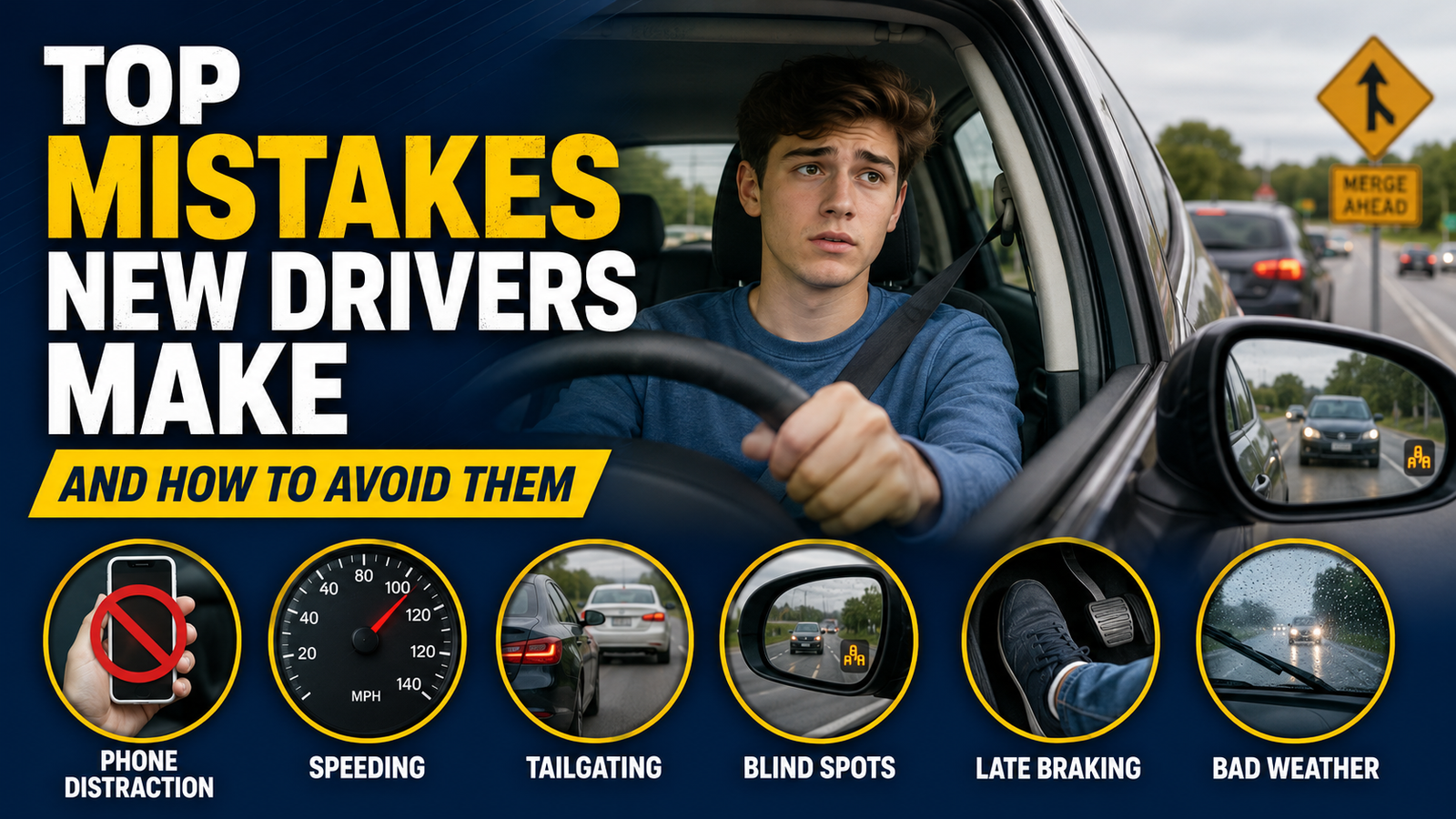
I remember sitting beside a new driver during one of his first solo-style practice drives.
He was not careless.
He was not trying to show off.
He was actually focused.
But that was the problem.
He was focusing on only one thing at a time.
First, he looked too long at the speedometer.
Then he forgot to check the mirror.
Then he turned without checking the blind spot.
Then he braked too late because he did not notice the car ahead slowing down.
Nothing terrible happened that day.
But it showed something important.
New drivers usually do not make mistakes because they do not care.
They make mistakes because driving feels simple from the outside but demands many small decisions at the same time.
Speed.
Mirrors.
Road signs.
Traffic lights.
Lane position.
Pedestrians.
Other drivers.
Weather.
Braking distance.
Blind spots.
Parking.
Phone distractions.
A new driver is still learning how to manage all of these things together.
That is why the first months and years of driving matter so much.
Good habits built early can protect you for life.
Bad habits built early can become dangerous without you realizing it.
This guide explains the top mistakes new drivers make, why they happen, and how to avoid them in a simple, practical way.
Important: Driving rules, licensing laws, speed limits, passenger restrictions, phone-use laws, and road-safety requirements vary by country and state. Always follow your local traffic laws, your driving instructor’s guidance, and your vehicle owner’s manual.
Table of Contents
- Quick Answer: What Mistakes Do New Drivers Make Most Often?
- Key Facts About New Driver Mistakes
- Getting Distracted by the Phone
- Driving Too Fast for the Situation
- Following Other Cars Too Closely
- Not Checking Mirrors and Blind Spots
- Braking Too Late or Too Suddenly
- Poor Lane Discipline
- Ignoring Seat Belts
- Driving Without Understanding Weather Conditions
- Not Knowing Basic Car Maintenance
- Becoming Overconfident Too Early
- Driving While Tired or Emotionally Upset
- Relying Too Much on Car Technology
- Simple Safe Driving Checklist for New Drivers
- Common Habits New Drivers Should Build Early
- When Should a New Driver Avoid Driving?
- FAQs About New Driver Mistakes
- Final Thoughts
- Sources and Further Reading
Quick Answer: What Mistakes Do New Drivers Make Most Often?
The most common mistakes new drivers make include:
- Using a phone while driving
- Speeding
- Following too closely
- Forgetting blind spots
- Braking too late
- Changing lanes without checking properly
- Not wearing a seat belt
- Driving too fast in rain, fog, or poor visibility
- Ignoring tire pressure and basic maintenance
- Becoming overconfident too quickly
- Driving while tired
- Trusting car technology too much
The biggest problem is not one single mistake.
The real danger is combining several small mistakes at once.
For example:
A new driver may be slightly speeding.
Then they glance at the phone.
Then the car ahead brakes.
Then they react late because they were following too closely.
That is how a normal drive can become dangerous within seconds.
Road-safety organizations consistently identify distraction, speeding, seat belt non-use, alcohol or drug impairment, nighttime driving, and passenger distraction as major risk factors for young and inexperienced drivers.
Key Facts About New Driver Mistakes
| Mistake | Why It Happens | Why It Is Dangerous | How to Avoid It |
|---|---|---|---|
| Phone distraction | New drivers underestimate risk | Takes eyes and mind off road | Put phone away before driving |
| Speeding | Overconfidence or pressure from traffic | Reduces reaction time | Drive for conditions, not ego |
| Tailgating | Poor distance judgment | Less time to brake | Keep a safe following gap |
| Blind spot mistakes | Forgetting shoulder checks | Can cause side collisions | Mirror, signal, shoulder check |
| Late braking | Not scanning far ahead | Can cause rear-end crashes | Look 10–15 seconds ahead |
| Poor lane control | Weak steering control | Drifting can surprise others | Keep steady lane position |
| No seat belt | Short-trip laziness | Higher injury risk | Buckle up every trip |
| Weather mistakes | Driving normally in rain/fog | Less grip and visibility | Slow down and increase distance |
| Maintenance neglect | Lack of car knowledge | Tires/brakes/lights may fail | Check basics monthly |
| Overconfidence | Early success feels easy | Risky habits increase | Keep learning after passing |
NHTSA reported that distracted driving claimed 3,208 lives in 2024, with more than 315,000 people injured in crashes involving distracted drivers.
1. Getting Distracted by the Phone
Phone use is one of the most dangerous mistakes a new driver can make.
A phone does not only distract your hands.
It distracts your eyes and your mind.
Even a quick glance can be risky because the road can change quickly.
A car may stop.
A pedestrian may step out.
A motorcycle may enter your blind spot.
A traffic light may change.
A child may run near the road.
For a new driver, this is even more dangerous because driving is not fully automatic yet. You are still learning how to manage steering, speed, signs, mirrors, braking, and traffic behavior.
Common phone mistakes
New drivers may:
- Read messages at red lights
- Change music while moving
- Hold the phone for navigation
- Reply quickly because “it will only take a second”
- Watch notifications
- Record videos while driving
- Use social media in traffic
- Keep the phone in their lap
Even if the car is moving slowly, distraction can still cause a crash.
IIHS says using a cellphone while driving increases crash risk, and texting or manipulating a phone has been consistently linked with higher crash risk.
How to avoid it
Before driving:
- Set navigation
- Choose music
- Put the phone on silent
- Use Do Not Disturb mode
- Place the phone out of reach
- Ask a passenger to handle calls or messages
- Stop safely if you must use the phone
Do not trust yourself to “just check quickly.”
The safest phone is the one you do not touch while driving.
2. Driving Too Fast for the Situation
Speeding is common among new drivers, especially after they gain a little confidence.
At first, new drivers may drive carefully.
Then after a few weeks, they may start thinking:
“I can handle this.”
“The road is clear.”
“Everyone else is driving fast.”
“I am only slightly above the limit.”
But speeding is not only about breaking the speed limit.
You can be driving at the legal limit and still be too fast for the situation.
Rain, fog, traffic, road damage, pedestrians, curves, and poor lighting can all make normal speeds unsafe.
Why speeding is dangerous
Speeding reduces:
- Reaction time
- Braking control
- Steering control
- Time to notice hazards
- Chance of avoiding a crash
It also increases crash severity.
For inexperienced drivers, speeding is especially risky because they may not yet judge distance, braking time, and road conditions accurately.
NHTSA reported that in 2024, speeding was a factor in 33% of passenger-vehicle teen drivers involved in fatal crashes.
How to avoid it
Use this simple rule:
Drive according to conditions, not only according to the posted limit.
Slow down when:
- Roads are wet
- Visibility is poor
- Traffic is heavy
- Pedestrians are nearby
- You are near schools
- Roads are narrow
- You are turning
- You are tired
- You feel nervous
A good driver is not the one who reaches fastest.
A good driver is the one who reaches safely.
3. Following Other Cars Too Closely
New drivers often follow too closely without realizing it.
They may think there is enough space.
But when the car ahead brakes suddenly, they discover the space was not enough.
This is one of the most common beginner mistakes.
Why tailgating happens
New drivers may follow too closely because:
- They copy other drivers
- They fear cars will cut in
- They do not understand stopping distance
- They are nervous in traffic
- They focus only on the bumper ahead
- They forget that braking takes time
A car does not stop the moment you press the brake.
There is reaction time first.
Then braking time.
Then road conditions matter.
Wet roads, worn tires, heavy vehicles, and high speed all increase stopping distance.
How to avoid it
Use a following-distance rule.
Choose a fixed object ahead, such as a sign or pole.
When the car in front passes it, count:
“One thousand one, one thousand two, one thousand three.”
If you reach the object before finishing the count, you are too close.
Increase the gap in:
- Rain
- Fog
- Night driving
- Heavy traffic
- High speed
- Poor road conditions
- Behind large vehicles
- When carrying passengers
More space gives you more time.
More time gives you better decisions.
4. Not Checking Mirrors and Blind Spots
Mirrors are important, but they do not show everything.
Every vehicle has blind spots.
A blind spot is an area around the car that you may not see clearly in the mirrors.
New drivers often forget this because they assume mirrors are enough.
They are not.
Common blind spot mistakes
New drivers may:
- Change lanes using only mirrors
- Forget shoulder checks
- Turn without checking for motorcycles
- Miss cyclists near the side
- Move off without checking surroundings
- Reverse without checking properly
- Rely only on the rear camera
This can cause side collisions, near misses, and dangerous lane changes.
How to avoid it
Before changing lanes, use this order:
- Check mirror.
- Signal.
- Check blind spot.
- Move smoothly if safe.
Do not turn your whole body for too long.
A quick shoulder check is enough.
Your eyes should return to the road ahead quickly.
Important tip
Motorcycles and bicycles can disappear into blind spots easily.
Always check carefully before turning, merging, or opening a door near traffic.
5. Braking Too Late or Too Suddenly
New drivers often brake late because they look only at the car directly ahead.
Experienced drivers scan further forward.
They notice traffic slowing before the nearest car brakes.
That gives them more time.
Common braking mistakes
New drivers may:
- Brake too late
- Brake too hard
- Panic brake in normal traffic
- Ride the brake pedal
- Brake while turning too sharply
- Not adjust braking in rain
- Forget that passengers and cargo add weight
Late braking can create panic for drivers behind you.
It can also cause skidding or loss of control in poor conditions.
How to avoid it
Look far ahead.
Do not only watch the car in front.
Watch:
- Traffic lights
- Brake lights ahead
- Pedestrians near crossings
- Road signs
- Parked cars
- Buses stopping
- Motorcycles filtering
- Road curves
- Speed bumps
Brake early and smoothly.
Smooth braking is safer, more comfortable, and better for the car.
6. Poor Lane Discipline
Lane discipline means keeping your car properly positioned in the lane and using lanes correctly.
New drivers may drift because they look too close in front of the car or hold the steering wheel too tightly.
They may also change lanes too often because they feel pressured by traffic.
Common lane mistakes
New drivers may:
- Drift toward one side
- Cut corners while turning
- Change lanes suddenly
- Forget indicators
- Stay in the wrong lane
- Drive too close to parked cars
- Enter roundabouts incorrectly
- Merge without enough speed or space
Poor lane discipline makes other drivers nervous because they cannot predict what you will do.
How to avoid it
Look where you want the car to go.
Do not stare at the road directly in front of the hood.
Keep your eyes ahead.
Hold the steering wheel calmly.
Signal early.
Avoid sudden lane changes.
Choose your lane in advance.
If you miss a turn, do not panic.
Continue safely and turn around later.
A missed turn is better than a dangerous turn.
7. Ignoring Seat Belts
Some new drivers wear seat belts during driving lessons but become careless later.
They may skip the seat belt on short trips.
They may think low-speed driving is safe.
They may forget to remind passengers.
This is a serious mistake.
Why seat belts matter
Seat belts help keep occupants inside the vehicle and reduce the risk of serious injury.
They also help airbags work properly.
Airbags are designed to work with seat belts, not replace them.
CDC says the simplest way to prevent car-crash deaths and injuries is to buckle up, and it reports that seat belts reduce the risk of dying or being seriously injured in a crash by about half.
How to avoid it
Build a simple habit:
The car does not move until everyone is buckled.
That includes:
- Driver
- Front passenger
- Rear passengers
- Short trips
- Slow roads
- Parking areas
- Night drives
- Family trips
Do not start the car and then wear the belt.
Wear the belt first.
Then drive.
8. Driving Without Understanding Weather Conditions
Many new drivers learn on clear roads and then struggle in rain, fog, wind, or night conditions.
Bad weather changes everything.
The road may become slippery.
Visibility may drop.
Other drivers may behave unpredictably.
Braking distance may increase.
Common weather mistakes
New drivers may:
- Drive normal speed in rain
- Brake hard on wet roads
- Follow too closely in fog
- Forget headlights
- Panic during skids
- Drive through deep water
- Use high beams incorrectly
- Ignore worn tires
Rain is especially dangerous because it reduces tire grip.
Fog is dangerous because drivers may not see hazards until late.
Night driving is harder because depth perception and visibility are reduced.
How to avoid it
In bad weather:
- Slow down
- Increase following distance
- Use headlights correctly
- Avoid sudden braking
- Avoid sharp steering
- Keep windows clear
- Use wipers and defogger
- Avoid flooded roads
- Pull over safely if visibility is too poor
If you are a new driver and the weather is severe, it is okay to delay the trip.
Confidence is good.
Overconfidence in bad weather is not.
9. Not Knowing Basic Car Maintenance
New drivers often focus only on driving skills.
But basic car maintenance is also part of safe driving.
A poorly maintained car is harder to control and more likely to break down.
Common maintenance mistakes
New drivers may ignore:
- Tire pressure
- Tire tread
- Engine oil
- Brake sounds
- Warning lights
- Wiper blades
- Headlights
- Coolant level
- Battery health
- Fluid leaks
Tires are especially important because they affect braking, steering, and grip.
A skilled driver still needs good tires.
How to avoid it
Learn simple monthly checks:
- Check tire pressure
- Look for tire damage
- Check oil level
- Test lights
- Check wipers
- Look under the car for leaks
- Notice dashboard warning lights
- Listen for brake noise
- Keep washer fluid filled
You do not need to become a mechanic.
You only need to notice problems early.
If something feels different, check it.
10. Becoming Overconfident Too Early
This is one of the most dangerous stages for new drivers.
At first, a beginner is careful because driving feels difficult.
After a few months, driving starts to feel easy.
That is when risky habits can appear.
Signs of overconfidence
A new driver may start:
- Speeding more often
- Taking turns faster
- Driving with one hand carelessly
- Using the phone
- Showing off with friends
- Ignoring mirrors
- Following too closely
- Driving while tired
- Thinking they can handle every situation
IIHS says teen drivers are about three times as likely as drivers age 20 and older to die in a crash, with immaturity and inexperience creating a high-risk combination.
How to avoid it
Remember this:
Passing the driving test does not mean you are done learning.
It means you are allowed to keep learning on real roads.
Keep improving:
- Practice parking
- Practice highway merging
- Practice night driving carefully
- Practice in light rain with supervision if needed
- Learn defensive driving
- Ask experienced drivers for feedback
- Avoid showing off
Good drivers stay humble.
Overconfident drivers stop improving.
11. Driving While Tired or Emotionally Upset
New drivers may not realize how much emotions affect driving.
Anger, stress, sadness, fear, and tiredness can all reduce focus.
Driving needs calm attention.
When your mind is somewhere else, your reaction time suffers.
Common emotional driving mistakes
New drivers may drive after:
- An argument
- Bad news
- Lack of sleep
- Long study or work hours
- Strong stress
- Crying
- Panic
- Excitement
- Peer pressure
Tired driving can be especially dangerous because the driver may not notice how slow their reactions have become.
How to avoid it
Before driving, ask:
“Am I calm enough to drive safely?”
If not:
- Wait a few minutes
- Drink water
- Breathe slowly
- Walk briefly
- Call someone
- Use public transport
- Ask another person to drive
Never use the car as a place to release anger.
The road is not the place to prove a point.
12. Relying Too Much on Car Technology
Modern cars can help drivers.
Features such as rear cameras, parking sensors, blind-spot alerts, lane assist, and automatic emergency braking can be useful.
But they are not replacements for driver attention.
A new driver may become too dependent on them.
Common technology mistakes
New drivers may:
- Reverse using only the camera
- Trust blind-spot alerts without checking
- Depend on lane assist
- Ignore mirrors because of sensors
- Drive too close because the car has emergency braking
- Use cruise control in unsuitable conditions
- Think driver-assistance features can drive the car
Technology can fail.
Sensors can be blocked by dirt, rain, snow, glare, or damage.
A warning may come late.
A camera may not show everything.
How to avoid it
Use technology as support, not as your main safety system.
Still check:
- Mirrors
- Blind spots
- Road signs
- Lane markings
- Pedestrians
- Traffic behavior
- Vehicle position
The driver is responsible.
Not the screen.
Not the sensor.
Not the warning beep.
Simple Safe Driving Checklist for New Drivers
Before driving:
- Adjust seat
- Adjust mirrors
- Wear seat belt
- Set navigation
- Put phone away
- Check fuel or charge level
- Check dashboard warning lights
- Make sure passengers are buckled
- Know your route
- Stay calm
While driving:
- Keep both eyes on the road
- Scan far ahead
- Check mirrors regularly
- Keep safe distance
- Signal early
- Avoid phone use
- Drive at a safe speed
- Watch pedestrians and cyclists
- Avoid aggressive drivers
- Stay in your lane
After driving:
- Park safely
- Use handbrake or parking brake
- Turn off lights if needed
- Lock the car
- Notice any new sounds, smells, or warning lights
Common Habits New Drivers Should Build Early
Habit 1: Mirror checks
Check mirrors before slowing, turning, changing lanes, or stopping.
Habit 2: Safe following distance
Never drive too close just because others do.
Habit 3: Smooth control
Smooth steering, braking, and acceleration make driving safer.
Habit 4: Early planning
Choose lanes early.
Do not make last-second moves.
Habit 5: No phone rule
Make phone-free driving your normal habit from the start.
Habit 6: Respect speed limits
Speed limits are not suggestions.
They are basic safety rules.
Habit 7: Defensive driving
Assume other drivers may make mistakes.
Leave yourself space and time.
Habit 8: Regular car checks
Safe driving also depends on a safe car.
When Should a New Driver Avoid Driving?
A new driver should avoid driving when:
- Very tired
- Angry or upset
- Weather is severe
- Visibility is very poor
- The car has brake problems
- The tire is damaged
- Warning lights are serious
- They feel panicked
- They are under pressure from friends
- They have consumed alcohol or drugs
- They are unfamiliar with difficult roads and have no support
There is no shame in waiting.
A smart driver knows when not to drive.
FAQs About New Driver Mistakes
What is the most common mistake new drivers make?
One of the most common mistakes is not paying enough attention to everything happening around the car. This includes phone distraction, poor mirror checks, late braking, and weak hazard awareness.
Why are new drivers more likely to crash?
New drivers have less experience judging speed, distance, road conditions, and other drivers’ behavior. They may also become distracted or overconfident more easily.
How can a new driver become more confident?
Practice regularly in different but safe conditions. Start with quiet roads, then gradually practice traffic, parking, night driving, and highways with guidance if needed.
Should new drivers avoid highways?
Not forever. But they should practice highways only when ready, preferably with an experienced driver at first. Merging, speed control, and lane discipline are important.
Is it bad to drive slowly as a new driver?
Driving safely is good, but driving too slowly can also be dangerous if it disrupts traffic. Drive at a safe, legal speed according to road conditions.
How often should new drivers check mirrors?
New drivers should check mirrors regularly and always before braking, turning, changing lanes, merging, or stopping.
Why are blind spots dangerous?
Blind spots can hide motorcycles, bicycles, pedestrians, or cars. Mirrors do not show everything, so shoulder checks are important.
What should a new driver do if they miss a turn?
Do not panic. Keep driving safely and find another legal route. Sudden last-minute turns can be dangerous.
Should new drivers drive with friends?
New drivers should be careful with passengers. Friends can distract the driver, create pressure, or encourage risky behavior.
How can new drivers avoid phone distraction?
Set navigation before driving, use Do Not Disturb mode, keep the phone out of reach, and stop safely before using it.
What is the best car for a new driver?
A good new-driver car should be reliable, easy to control, fuel-efficient, safe, and not too powerful. Good visibility and simple controls are also helpful.
Should new drivers learn basic maintenance?
Yes. New drivers should know how to check tire pressure, oil level, lights, wipers, warning lights, and visible tire damage.
Is overconfidence dangerous for new drivers?
Yes. Many new drivers become risky after gaining early confidence. Safe driving requires continued learning and humility.
What should new drivers do in rain?
Slow down, increase following distance, use headlights correctly, avoid sudden braking, and stay extra alert for pedestrians, puddles, and reduced grip.
Can car safety technology replace driver skills?
No. Safety technology can help, but it cannot replace attention, judgment, mirror checks, safe speed, and proper control.
Final Thoughts
New drivers make mistakes.
That is normal.
Driving is a skill, and every skill takes time.
But some mistakes are too dangerous to treat casually.
A quick phone glance.
A little speeding.
A missed blind spot.
A late brake.
A forgotten seat belt.
A risky lane change.
Each one may seem small.
But on the road, small mistakes can become serious very quickly.
The goal is not to become perfect overnight.
The goal is to build safe habits early.
Put the phone away.
Wear the seat belt.
Keep your distance.
Check mirrors.
Respect speed.
Slow down in bad weather.
Do not show off.
Do not panic.
Do not stop learning after passing the test.
A good driver is not the one who drives fast.
A good driver is the one who stays aware, calm, prepared, and responsible.
New drivers who learn this early become safer drivers for life.
Sources and Further Reading
- National Highway Traffic Safety Administration — Teen Driving Safety and major risk factors.
- National Highway Traffic Safety Administration — Distracted Driving facts and 2024 crash data.
- National Highway Traffic Safety Administration — Parent guide on teen driver risks and speeding.
- Centers for Disease Control and Prevention — Risk factors for teen drivers.
- Insurance Institute for Highway Safety — Young driver safety and teen crash risk.
- Insurance Institute for Highway Safety — Distracted driving research overview.
- Your local driving handbook and traffic laws
- Your vehicle manufacturer’s owner’s manual
About the Author