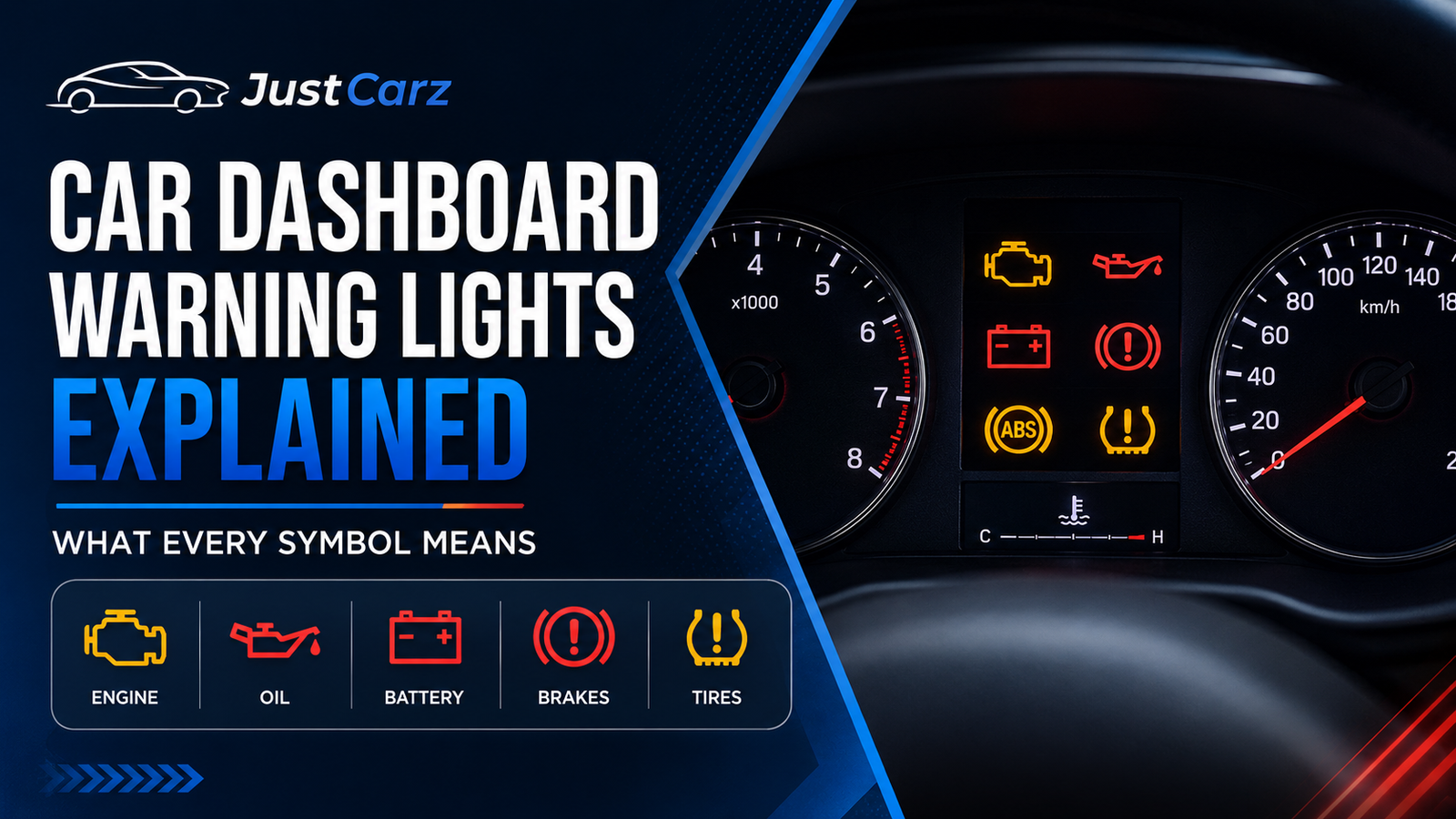
Modern car dashboard displaying several illuminated warning lights, including the check-engine, oil-pressure, battery, brake, and tire-pressure symbols.
I remember the first time an unfamiliar warning light appeared on my dashboard.
It was a small orange symbol shaped like an engine.
The car still sounded normal. It accelerated normally. There was no smoke, strange smell, or unusual vibration.
For a moment, I wondered whether I could simply ignore it.
Then another question appeared:
What if the car is warning me before the problem becomes serious?
Dashboard lights are the car’s way of communicating with the driver.
Some lights only confirm that a feature is active. Others tell you that the vehicle needs attention. A few warn about problems that could damage the engine, affect braking, or create an immediate safety risk.
The difficult part is knowing which is which.
A red oil light does not mean the same thing as a green cruise-control symbol. A flashing check-engine light is generally more urgent than a steady one. A tire-pressure warning may indicate a slowly leaking tire, while a red temperature light may mean the engine is overheating.
Understanding these symbols can help you react calmly instead of guessing.
This guide explains the most common car dashboard warning lights, what they usually mean, and what you should do when they appear.
Important: Dashboard symbols and their exact meanings vary between manufacturers, models, engines, and model years. Always check your vehicle’s owner’s manual for instructions specific to your car.
Table of Contents
- Quick Answer: What Do Dashboard Warning Lights Mean?
- Dashboard Warning-Light Colors Explained
- Key Dashboard Warning-Light Facts
-
- Check-Engine Warning Light
-
- Engine Oil-Pressure Warning Light
-
- Battery or Charging-System Warning Light
-
- Engine Coolant-Temperature Warning Light
-
- Brake-System Warning Light
-
- ABS Warning Light
-
- Tire-Pressure Warning Light
-
- Airbag or SRS Warning Light
-
- Traction-Control Warning Light
-
- Electronic Stability-Control Warning Light
-
- Power-Steering Warning Light
-
- Transmission-Temperature Warning Light
-
- Low-Fuel Warning Light
-
- Seat-Belt Reminder Light
-
- Door, Hood, or Trunk Warning Light
-
- Windshield-Washer-Fluid Warning Light
-
- Diesel Glow-Plug Warning Light
-
- Diesel Particulate Filter Warning Light
-
- DEF or AdBlue Warning Light
-
- Lane-Assist Warning Light
-
- Forward-Collision Warning Light
-
- Blind-Spot Monitoring Warning Light
-
- Automatic Emergency-Braking Warning Light
-
- Hybrid-System Warning Light
-
- Electric-Vehicle Battery Warning Light
- What to Do When a Warning Light Appears
- Common Dashboard Warning-Light Mistakes
- When Should You Stop Driving Immediately?
- Why Dashboard Warning Lights Matter
- FAQs About Dashboard Warning Lights
- Final Thoughts
- Sources and Further Reading
Quick Answer: What Do Dashboard Warning Lights Mean?
Dashboard warning lights tell you about the condition of your vehicle.
They may indicate:
- A serious mechanical problem
- A safety-system fault
- Low fluid or tire pressure
- A feature currently in use
- A maintenance requirement
- An open door or unfastened seat belt
- A driver-assistance system that has been disabled
- A temporary system check after starting the car
A simple way to understand them is by color:
- Red usually means urgent attention is required
- Amber or yellow usually means check the vehicle soon
- Green usually means a feature is active
- Blue usually indicates a lighting or information function
- White may display general vehicle information
The color system is helpful, but it is not universal.
The same symbol can behave differently depending on whether it is solid, flashing, or accompanied by a message.
Dashboard Warning-Light Colors Explained
Red warning lights
Red lights normally indicate an urgent condition.
They may relate to:
- Oil pressure
- Engine temperature
- Braking
- Charging system
- Airbags
- Seat belts
- Open doors
- Serious electric or hybrid faults
A red light does not always mean the engine is about to fail. A red seat-belt reminder, for example, usually means someone has not fastened their seat belt.
However, an unexplained red warning should never be ignored.
Amber or yellow warning lights
Amber lights normally mean that something needs inspection or service.
The vehicle may still be drivable, but the system could be limited, disabled, or developing a fault.
Examples include:
- Check-engine light
- ABS warning
- Tire-pressure warning
- Traction-control fault
- Diesel particulate filter warning
- Blind-spot monitoring fault
Green warning lights
Green lights usually confirm that a feature is active.
Examples include:
- Cruise control
- Turn signals
- Parking lights
- Automatic hold
- Eco driving mode
These are normally informational rather than warnings.
Blue warning lights
Blue is most commonly used for high-beam headlights.
It may also appear for certain temperature or information indicators, depending on the vehicle.
White warning lights
White dashboard symbols are generally used for information, instructions, or system status.
For example, a white symbol may tell you to press the brake pedal before starting the engine or changing gear.
Key Dashboard Warning-Light Facts
| Warning Light | Typical Meaning | General Urgency |
|---|---|---|
| Check engine | Engine or emissions fault | Medium to high |
| Oil pressure | Low engine oil pressure | Very high |
| Battery | Charging-system problem | High |
| Temperature | Engine overheating | Very high |
| Brake | Parking brake, low fluid, or brake fault | High |
| ABS | Anti-lock braking fault | Medium to high |
| Tire pressure | One or more tires may be underinflated | Medium |
| Airbag | Airbag or restraint-system fault | High |
| Traction control | System operating or malfunctioning | Low to medium |
| Power steering | Steering-assistance fault | High |
| Transmission temperature | Transmission may be overheating | High |
| Low fuel | Fuel level is low | Low |
| Seat belt | Occupant is not buckled | High safety importance |
| DPF | Diesel filter may need regeneration | Medium |
| Forward collision | Collision risk or system fault | High |
1. Check-Engine Warning Light
The check-engine light usually looks like a small engine.
It may also display words such as:
- Check Engine
- Service Engine Soon
- Engine Fault
- Emissions System
The light is connected to the vehicle’s onboard diagnostic system.
It can appear because of problems involving:
- Engine sensors
- Fuel delivery
- Ignition
- Emissions equipment
- Air intake
- Exhaust system
- Catalytic converter
- Loose or damaged fuel cap
Steady check-engine light
A steady light often means the vehicle has detected a fault that should be diagnosed soon.
If the car feels normal, you may be able to drive carefully to a safe location or repair shop.
However, check the owner’s manual first.
Also pay attention to:
- Reduced power
- Rough idling
- Difficult starting
- Unusual fuel consumption
- Smoke
- Strange noises
- Fuel smell
Flashing check-engine light
A flashing check-engine light is generally more urgent.
It can indicate a severe engine misfire that may damage the catalytic converter or other components.
Reduce speed, avoid hard acceleration, and stop in a safe place.
Arrange professional assistance if the light continues flashing.
What should you do?
- Check whether the fuel cap is loose.
- Look for other warning lights.
- Notice whether the engine is running normally.
- Avoid heavy acceleration or towing.
- Arrange a diagnostic scan.
Do not disconnect the battery simply to make the warning disappear.
That may erase useful diagnostic information without fixing the problem.
2. Engine Oil-Pressure Warning Light
The oil-pressure light normally looks like an old-fashioned oil can.
This is one of the most serious dashboard warnings.
It may indicate that engine oil is not circulating with enough pressure.
Possible causes include:
- Low engine-oil level
- Oil leak
- Failed oil pump
- Blocked oil filter
- Internal engine wear
- Faulty pressure sensor
Oil creates a protective layer between moving engine components.
Without proper pressure, those components can overheat, grind together, and suffer severe damage.
What should you do?
- Pull over as soon as it is safe.
- Switch off the engine.
- Wait for the engine to settle.
- Check the oil level if you know how.
- Look under the car for visible leaks.
- Do not continue driving if the light remains on.
Adding oil may help if the level is low, but it will not fix a failed pump, blocked passage, or major leak.
If the oil level is normal and the light remains illuminated, arrange roadside assistance.
3. Battery or Charging-System Warning Light
The battery warning light normally looks like a rectangular battery with positive and negative symbols.
Many people assume this light only means the battery is old.
However, it normally warns about the vehicle’s charging system.
Possible causes include:
- Failing alternator
- Loose or broken drive belt
- Damaged battery cables
- Weak battery
- Faulty voltage regulator
- Wiring problem
- Poor electrical connection
The car may continue running temporarily using stored battery power.
Once that power is used, the engine may stop.
What should you do?
- Turn off unnecessary electrical equipment.
- Avoid switching off the engine until you are safely parked.
- Move to a safe location.
- Do not continue a long journey.
- Have the charging system tested.
If the steering becomes heavy or the temperature begins rising at the same time, a broken belt may be affecting multiple systems.
Stop driving safely and request assistance.
4. Engine Coolant-Temperature Warning Light
The temperature warning often looks like a thermometer above wavy lines.
It means the engine may be overheating.
Possible causes include:
- Low coolant level
- Coolant leak
- Failed radiator fan
- Faulty thermostat
- Broken water pump
- Blocked radiator
- Damaged hose
- Heavy engine load
An overheating engine can suffer serious damage.
What should you do?
- Turn off the air conditioning.
- Pull over safely.
- Switch off the engine.
- Allow the engine to cool.
- Do not open a hot radiator cap.
- Check for leaks only after the engine has cooled.
- Arrange professional help if the problem remains.
Hot cooling systems are pressurized.
Opening the cap while the engine is hot can release boiling coolant and steam.
5. Brake-System Warning Light
The brake warning normally appears as an exclamation mark inside a circle, the word “BRAKE,” or a similar symbol.
It may mean:
- The parking brake is applied
- Brake-fluid level is low
- There is a hydraulic brake fault
- Brake pads are worn
- Electronic brake control has detected a problem
First, make sure the parking brake is fully released.
If the light remains on, take the warning seriously.
Stop driving when:
- The brake pedal feels soft
- The pedal travels farther than normal
- The vehicle pulls during braking
- Braking distance has increased
- You hear grinding
- Brake fluid is visibly leaking
- The red brake and ABS lights appear together
Move to a safe place and arrange inspection.
6. ABS Warning Light
ABS stands for Anti-lock Braking System.
The ABS light normally displays the letters “ABS” inside a circle.
ABS helps prevent the wheels from locking during hard braking.
If the ABS light remains on, normal braking may still operate, but the anti-lock function may be unavailable.
This means the wheels could lock during emergency braking, especially on wet, icy, or loose surfaces.
What should you do?
- Drive cautiously.
- Avoid sudden braking.
- Increase your following distance.
- Have the ABS system inspected promptly.
- Stop driving if the red brake warning is also illuminated.
The ABS light may briefly appear when the vehicle starts as part of a normal system check.
It should usually turn off shortly afterward.
7. Tire-Pressure Warning Light
The tire-pressure monitoring system light looks like an exclamation mark inside a horseshoe-shaped tire.
It usually means that one or more tires may be underinflated.
Possible causes include:
- Natural pressure loss
- Temperature changes
- Slow puncture
- Damaged valve
- Nail or screw in the tire
- Tire damage
- Faulty TPMS sensor
Underinflated tires can affect:
- Braking
- Handling
- Fuel efficiency
- Tire wear
- Heat buildup
- Blowout risk
What should you do?
- Reduce speed.
- Stop somewhere safe.
- Inspect all tires visually.
- Use a pressure gauge.
- Inflate tires to the manufacturer’s recommended cold pressure.
- Check for punctures or damage.
Use the pressure listed on the driver’s door frame, fuel flap, or owner’s manual.
Do not automatically use the maximum pressure written on the tire sidewall.
What if the TPMS light flashes?
A flashing light followed by steady illumination may indicate a monitoring-system fault rather than low pressure alone.
Have the system inspected.
8. Airbag or SRS Warning Light
The airbag warning usually shows a seated person with a circle in front of them.
It may also display:
- SRS
- Airbag
- Restraint System
If the light remains on, the vehicle may have detected a fault involving:
- Airbags
- Seat-belt pretensioners
- Occupant sensors
- Impact sensors
- Wiring
- Restraint-control module
The car may still drive normally, but one or more airbags might not operate correctly during a collision.
Arrange inspection as soon as possible.
Do not attempt to repair airbag wiring yourself unless you are professionally trained.
Airbag systems contain explosive devices and stored electrical energy.
9. Traction-Control Warning Light
The traction-control symbol normally shows a car with wavy skid lines underneath it.
If the light flashes while driving, the system may be actively reducing wheelspin.
This can happen during:
- Hard acceleration
- Rain
- Snow
- Ice
- Loose gravel
- Mud
A flashing light in these conditions is often normal.
Reduce acceleration and drive smoothly.
If the light remains on continuously, the system may be:
- Manually switched off
- Temporarily unavailable
- Experiencing a sensor fault
- Affected by an ABS problem
Check whether you accidentally pressed the traction-control-off button.
10. Electronic Stability-Control Warning Light
Electronic Stability Control helps the driver maintain control when the vehicle begins to slide or turn differently from the intended direction.
The symbol may look similar to the traction-control light.
Flashing light
The system may be actively correcting the vehicle.
Slow down and avoid sudden steering or acceleration.
Steady light
The system may be disabled or malfunctioning.
Because stability control often uses ABS wheel-speed sensors, an ABS fault can sometimes trigger both warnings.
11. Power-Steering Warning Light
The power-steering light often looks like a steering wheel with an exclamation mark.
It may indicate a problem with:
- Electric power steering
- Hydraulic power steering
- Steering sensor
- Electrical supply
- Power-steering fluid
- Steering-assistance motor
The steering wheel may become much harder to turn.
What should you do?
- Slow down safely.
- Avoid sharp movements.
- Pull over if steering assistance is reduced.
- Restart the vehicle only if the manual recommends it.
- Check hydraulic fluid where applicable.
- Arrange professional inspection.
You may still be physically able to steer the vehicle, but low-speed turns can require much more effort.
12. Transmission-Temperature Warning Light
The transmission-temperature symbol may show a thermometer inside a gear.
It means the transmission fluid may be overheating.
This can happen because of:
- Heavy towing
- Steep hills
- Hot weather
- Low transmission fluid
- Internal transmission fault
- Cooling-system problem
- Excessive slipping
Continuing to drive with an overheating transmission can cause expensive damage.
What should you do?
Pull over safely and follow the instructions in the owner’s manual.
Some vehicles recommend selecting Park and allowing the engine to idle. Others may require the engine to be switched off.
Do not guess, because the correct procedure varies by vehicle.
13. Low-Fuel Warning Light
The low-fuel light normally looks like a fuel pump.
It means the fuel level has reached the vehicle’s reserve range.
The remaining distance can vary based on:
- Vehicle model
- Driving speed
- Traffic
- Road gradient
- Weather
- Load
- Fuel economy
Do not assume you can travel a fixed distance after the light appears.
Running extremely low on fuel can leave you stranded and may affect certain fuel-system components.
Refuel as soon as reasonably possible.
14. Seat-Belt Reminder Light
The seat-belt light normally shows a seated person wearing a belt.
It indicates that the driver or a passenger has not fastened their seat belt.
Some cars also use seat sensors to detect objects placed on the passenger seat.
If the light remains on despite everyone wearing a belt:
- Remove heavy objects from the seat.
- Refasten each seat belt.
- Check for damaged buckles.
- Have the occupant sensor inspected if necessary.
15. Door, Hood, or Trunk Warning Light
This light indicates that a door, the hood, or the trunk may not be fully closed.
Do not ignore it.
An unsecured door or trunk can open while driving. An improperly latched hood can lift and block your view.
Stop safely and check every opening.
16. Windshield-Washer-Fluid Warning Light
The washer-fluid symbol usually looks like a windshield with water spraying above it.
It means the washer-fluid reservoir is low.
This is not normally a mechanical emergency, but clear visibility is essential for safe driving.
Refill the reservoir with suitable washer fluid.
Do not use plain water in freezing conditions because it can freeze inside the system.
17. Diesel Glow-Plug Warning Light
Diesel vehicles may display a coil-shaped glow-plug light.
When you switch on the ignition, the light may appear while the glow plugs warm the engine.
Normally, you should wait for it to turn off before starting.
If the light:
- Stays on
- Flashes
- Appears while driving
- Is accompanied by reduced power
there may be a problem with the glow plugs, engine management, fuel system, or another diesel component.
Arrange a diagnostic inspection.
18. Diesel Particulate Filter Warning Light
The diesel particulate filter, or DPF, captures soot from diesel exhaust gases.
Its warning light may appear when the filter becomes heavily loaded.
Some vehicles can clean the filter through a process called regeneration.
Frequent short journeys can prevent the exhaust from becoming hot enough to complete this process.
What should you do?
Follow the vehicle manufacturer’s regeneration instructions.
This may involve driving at a specified speed and engine temperature for a certain period.
Do not attempt a high-speed drive without checking the manual.
If the light remains on, flashes, or appears with an engine warning, seek professional service.
A severely blocked filter can cause reduced power and expensive damage.
19. DEF or AdBlue Warning Light
Some modern diesel vehicles use Diesel Exhaust Fluid, often called DEF or AdBlue, to reduce certain exhaust emissions.
The warning light may indicate:
- Low fluid level
- Incorrect fluid
- Frozen fluid
- System malfunction
- Limited remaining starts
Refill only with the correct approved fluid.
Do not pour DEF into the diesel fuel tank.
If the system reaches empty, some vehicles may not restart after the engine is switched off.
20. Lane-Assist Warning Light
Lane-assist systems use cameras or sensors to identify lane markings.
The symbol may show a car between two lines.
Different colors can indicate:
- The system is active
- Lane markings are detected
- The system is unavailable
- The driver is leaving the lane
- A camera is blocked
- A fault has occurred
Lane assist may stop working because of:
- Dirt on the windshield
- Heavy rain
- Fog
- Snow
- Faded road markings
- Bright sunlight
- Camera misalignment
Clean the camera area and check the owner’s manual.
Driver-assistance technology does not replace attentive driving.
21. Forward-Collision Warning Light
The forward-collision warning may show two vehicles with an impact symbol between them.
A red or flashing warning can mean the system has detected a possible collision.
Take immediate control.
Depending on the situation:
- Brake firmly
- Reduce speed
- Increase following distance
- Steer away only when safe
- Pay attention to vehicles and pedestrians
An amber light may mean the system is disabled, blocked, or experiencing a fault.
22. Blind-Spot Monitoring Warning Light
Blind-spot monitoring normally uses lights in the side mirrors.
A light may illuminate when another vehicle enters the monitored area.
If it flashes while your turn signal is active, the system may be warning against changing lanes.
A dashboard warning may mean the system is:
- Unavailable
- Switched off
- Blocked by dirt, snow, or ice
- Experiencing a sensor fault
Always check mirrors and look over your shoulder before changing lanes.
Blind-spot monitoring is an assistance feature, not a replacement for direct observation.
23. Automatic Emergency-Braking Warning Light
Automatic emergency braking can apply the brakes when the system detects a potential collision.
A warning may appear when:
- A collision risk is detected
- The system is disabled
- A sensor is blocked
- The system has malfunctioned
- The feature is temporarily unavailable
Keep control of the vehicle and brake when necessary.
Never wait for the system to brake for you.
24. Hybrid-System Warning Light
Hybrid vehicles may display a warning symbol involving a car, battery, or exclamation mark.
It can indicate a problem with:
- High-voltage battery
- Hybrid motor
- Inverter
- Cooling system
- Regenerative braking
- Power-control electronics
A serious hybrid warning may require you to stop the vehicle.
Do not touch orange high-voltage cables or connectors.
Hybrid systems operate at dangerous voltage levels and should only be serviced by trained technicians.
25. Electric-Vehicle Battery Warning Light
Electric vehicles use several battery and power-system indicators.
A warning may relate to:
- Low driving range
- High-voltage battery fault
- Battery overheating
- Charging problem
- Reduced power
- Electrical-system malfunction
- Battery cooling fault
Some electric vehicles display a turtle symbol when power is severely limited.
If the vehicle loses power, displays a red battery warning, or reports a high-voltage fault, stop safely and contact roadside assistance.
What to Do When a Warning Light Appears
When a dashboard light comes on, follow these steps.
Step 1: Stay calm
Do not brake suddenly or make a dangerous turn because a warning appeared.
Keep control of the vehicle.
Step 2: Notice the color
Red normally requires more urgent attention than amber, green, blue, or white.
Step 3: Check whether it is flashing
A flashing warning often indicates a more urgent or active condition.
Step 4: Look for other symptoms
Notice:
- Strange sounds
- Smoke
- Burning smell
- Reduced power
- Heavy steering
- Poor braking
- Vibration
- High temperature
- Fluid leaks
Step 5: Find a safe place
If the problem appears serious, signal and move away from traffic.
Step 6: Read the dashboard message
Modern vehicles often display text explaining the symbol.
Step 7: Check the owner’s manual
The manual provides instructions for your exact model.
Step 8: Contact professional help
When in doubt, contact:
- Roadside assistance
- A qualified mechanic
- An authorized repair center
- The manufacturer’s support service
Common Dashboard Warning-Light Mistakes
Mistake 1: Ignoring a red warning
A red oil, brake, temperature, or charging warning may indicate an urgent problem.
Mistake 2: Assuming every light means the car will stop immediately
Some symbols simply show that a feature is active.
Learn the difference between warning lights and indicator lights.
Mistake 3: Continuing to drive an overheating engine
A short additional drive can turn a manageable cooling problem into major engine damage.
Mistake 4: Opening a hot radiator cap
Hot coolant can escape under pressure and cause serious burns.
Mistake 5: Adding oil without checking the level
Too much oil can also cause problems.
Check the dipstick and use the correct oil specification.
Mistake 6: Resetting the warning without repairing the fault
Clearing a code does not repair the vehicle.
Mistake 7: Assuming the tire-pressure light identifies the exact tire
Some systems only warn that at least one tire is low.
Check every tire.
Mistake 8: Relying entirely on driver-assistance systems
Lane assist, blind-spot monitoring, and automatic braking can become unavailable or fail to detect certain hazards.
Mistake 9: Using online images without checking the manual
Symbols can look similar while representing different systems.
Mistake 10: Ignoring warning lights before buying a used car
An illuminated warning may reveal an existing mechanical, electrical, emissions, or safety-system problem.
When Should You Stop Driving Immediately?
Stop as soon as it is safe when you see a serious warning involving:
- Engine oil pressure
- Engine overheating
- Brake-system failure
- Major steering fault
- Transmission overheating
- High-voltage battery fault
- Severe charging-system problem
- Flashing check-engine light with rough running
- Smoke or burning smell
- Rapid fluid loss
Also stop when the vehicle develops:
- Poor braking
- Very heavy steering
- Loud mechanical knocking
- Severe vibration
- Sudden loss of power
- Steam from the engine
- A tire that is rapidly losing pressure
Activate your hazard lights and move as far away from traffic as possible.
Do not stand in an unsafe location beside a busy road.
Why Dashboard Warning Lights Matter
Dashboard warnings are easy to ignore when the car still appears to drive normally.
But warning lights often appear before the driver can see or hear the problem.
They can help identify:
- Low oil pressure before engine failure
- Low tire pressure before tire damage
- Cooling problems before severe overheating
- Brake faults before braking performance becomes worse
- Charging faults before the vehicle loses electrical power
- Safety-system problems before a collision occurs
The warning light is not the problem itself.
It is a message about the problem.
Covering the light, resetting the dashboard, or hoping it disappears does not fix the cause.
Understanding the warning gives you time to make a safer and often less expensive decision.
FAQs About Dashboard Warning Lights
What is the most serious dashboard warning light?
Oil-pressure, engine-temperature, and brake-system warnings are among the most serious. Their urgency depends on the vehicle and the symptoms present.
Can I drive with the check-engine light on?
You may be able to drive a short distance if the light is steady and the vehicle feels normal. A flashing light, rough running, smoke, or major power loss requires urgent attention.
What does a red dashboard light mean?
Red generally indicates an urgent warning, safety issue, or condition requiring immediate attention.
What does an amber dashboard light mean?
Amber or yellow usually means that a system needs inspection, service, or corrective action soon.
What do green and blue dashboard lights mean?
Green and blue lights usually indicate that a feature is operating, such as cruise control, turn signals, or high-beam headlights.
Why do all my dashboard lights come on when I start the car?
Many vehicles illuminate dashboard lights briefly as a system test. They should normally turn off after the engine starts.
Why is my check-engine light on but the car drives normally?
The vehicle may have detected an emissions, sensor, ignition, or fuel-system fault that has not yet caused obvious symptoms.
Can a loose fuel cap cause the check-engine light?
On some vehicles, a loose, damaged, or missing fuel cap can trigger an emissions-system warning.
Can cold weather turn on the tire-pressure light?
Yes. Tire pressure decreases as temperature falls. Check and adjust the tires to the manufacturer’s recommended cold pressure.
Why is the tire-pressure light still on after inflation?
The system may need time to update, require a reset, detect another low tire, or have a faulty sensor.
What should I do if the oil light appears?
Pull over safely, switch off the engine, and check the oil level after allowing the vehicle to settle. Do not continue driving if the warning remains on.
Can I drive with the ABS light on?
Normal braking may remain available, but anti-lock braking may not work. Drive cautiously and arrange prompt inspection. Do not continue if the red brake warning is also on.
Why is the traction-control light flashing?
A flashing light often means the system is actively reducing wheelspin or helping stabilize the vehicle.
What does the steering-wheel warning light mean?
It normally indicates a problem with the power-steering system. Steering may become much harder.
What does a thermometer warning light mean?
It usually means the engine coolant is too hot or that the cooling system has detected a problem.
Can warning lights disappear by themselves?
Some temporary warnings may turn off after conditions return to normal. The vehicle may still store a diagnostic fault code.
Should I buy a used car with a warning light on?
Only after the cause has been professionally diagnosed and included in your price and repair decision.
Can a weak battery cause multiple warning lights?
Yes. Low or unstable voltage can sometimes trigger several electrical and system warnings.
Are dashboard symbols the same in every car?
No. Many are similar, but designs, colors, meanings, and recommended actions vary by manufacturer and model.
Where can I find the exact meaning of a warning light?
Check the dashboard section of your vehicle’s owner’s manual or the manufacturer’s official owner-support website.
Final Thoughts
Dashboard warning lights can feel confusing because they appear as small symbols without a complete explanation.
An engine shape.
An oil can.
A battery.
A thermometer.
A steering wheel.
A tire with an exclamation mark.
Each symbol is a short message from the vehicle.
Some messages say:
“A feature is working.”
Others say:
“Please check this soon.”
And a few say:
“Stop before something becomes dangerous or expensive.”
You do not need to become a mechanic to understand your dashboard.
You only need to recognize the most important symbols, pay attention to their colors, notice how the vehicle feels, and check the instructions for your specific model.
The next time a warning light appears, do not panic.
Do not ignore it either.
Slow down, identify the symbol, find a safe place when necessary, and respond to the problem while it is still a warning.
Sources and Further Reading
- Ford Owner Support — Dashboard Warning Lights
- Toyota Owners — Dashboard Warning Lights Explained
- Volkswagen Owners and Services — Car Warning Lights
- National Highway Traffic Safety Administration — Tire Safety and TPMS
- Vehicle manufacturer owner’s manuals
- Authorized vehicle repair and roadside-assistance guidance
About the Author